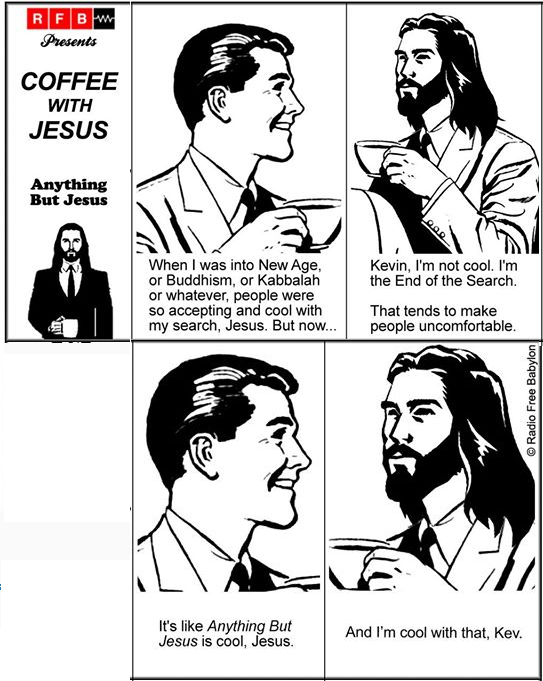
I usually like "Coffee with Jesus," but today's strip is one that I feel misses the mark and misunderstands the essential appeal of Jesus.
Produced by Radio Free Babylon, "Coffee with Jesus" is a webcomic about prayer that appears on the Facebook page of its creators. The strip features a regular cast of characters as they talk with Jesus over a cup of coffee. The strips aren't funny as much as they are thoughtful, occasionally poignant, and more often thought-provoking.
Today's strip features Kevin, who until recently was the strip's skeptic, a fellow who spoke with Jesus honestly and pointed out the problems he had with Christians, with the church and with belief. His prayer brings up a topic I've noticed a lot in the churches I've attended: that people are okay with spirituality and spiritualism, but intolerant of any mention of Jesus.
I've always found this complaint a little odd. People don't appreciate being prosyletized, but that's true whether you're pushing them to accept Jesus, to become a vegetarian, or to pull up their roots and move to Alaska with you because there's supposed to be good fishing in Skagway.
But once it's clear that you're not pushing, people are by and large fine with hearing about what you've found in Jesus, Buddha or Shintoism; they're generally impressed that you decided to become a pescetarian, a vegetarian or a raw vegan; and they're downright excited to hear your plans to move to Skagway, Sitka or Haines -- just as long as you're not going to Kake.
It's a popular theme in evangelical circles especially that people hate Christians and that everyone had it in for Jesus, but that's not what the Bible shows. The gospel account is that Jesus was arrested and tried in secret, and then crucified, not because he was unpopular but because he was insanely popular with the people and the priests feared a riot.
And why wouldn't they? Jesus' message of justice and renewal is one that should and does resonate with many people. When it doesn't, I think it says more about the audience (too comfortable) or the messenger (the church) than it does about the message.
The crowd that picked the release of Barabbas over Jesus on Good Friday wasn't doing this because they hated Jesus. They were demanding the release of a popular hero against Roman rule, one whose followers knew he had been arrested and who had time to organize a group to petition Pilate for his release. Jesus was arrested late at night in secrecy and sentenced that morning. In other words, the crowd was stacked, and not the fickle, flip-flopping capricious mob of Good Friday sermons.
But doesn't the Bible say that the world hated Jesus? Doesn't Jesus himself warn his disciples and the church that they will be hated on his account? Well, yes, it does. It's right there in John 15: “If the world hates you, keep in mind that it hated me first. If you belonged to the world, it would love you as its own. As it is, you do not belong to the world, but I have chosen you out of the world. That is why the world hates you."
But let's make sure we understand what Jesus is saying. The Bible was written in Greek, not in English; and as anyone who speaks more than language will attest, not everything translates perfectly. In this case, the Greek word we translate as "world" in John 15:18 is kosmos. Kosmos doesn't mean "everyone," it means "everything"; more specifically, the way everything is arranged.
A man like Jesus, someone who disregards social conventions for who is in and who is out; whose presence ends disease and the finality of death, and who threatens social hierarchy by treating outcasts with the utmost respect, is someone the kosmos will hate. He's a threat to the way things are, now just as much as then.
How individual people respond to him often depends on where they stand in the structure of the kosmos. The powerful feared Jesus would lead a popular uprising, and doubtless some zealots and others thought he would as well, but for all the emphasis we place on that view, it was hardly the only one at work. There were many others with different understandings of who Jesus was and what he was about, including prophet, teacher and holy man, and not political revolutionary.
It's pretty evident that the people loved Jesus because of the kind of guy he was. He healed the sick, talked to outcasts, and treated the poor with the same respect he afforded the wealthy. The common people approached him with appeals to his compassion for healing, not from an anti-Roman bent asking him to drive out the local garrison.
Jesus isn't trendy the way the latest pop artist is, or in the same way as the hot new show on Netflix. But his message of radical acceptance, and apocalyptic restructuring so that justice breaks forth right now, is a message that billions have responded to in faith since it was first proclaimed in the desert of Galilee.
It's a message with universal relevance and appeal to the weary and the discarded, and it doesn't get cooler than that.
Copyright © 2017 by David Learn. Used with permission.
Tweet
Showing posts with label Christianity. Show all posts
Wednesday, February 15, 2017
Wednesday, November 09, 2016
keeping the faith in a trump presidency
Let's talk for a moment about our president-elect.
During the past year, Trump has maligned Hispanics, villified Muslims, mocked the disabled, spread racist lies about blacks and Jews, advocated violence against his critics, and bragged about sexually assaulting women.
He has attacked the legitimacy of major institutions in this country: the news media, the Congress, both parties, our political process, our intelligence agencies and our military. He has indicated he would like to weaken the protections of the First Amendment itself, to make it easier to sue people who criticize him or who he feels treat him "unfairly." He has shown support for ending marriage equality, and for chipping away at the recently enacted protections for transgender youth at schools.
His business record is an open drain, one where he once lost nearly $1 billion in a single year and and where he has filed for personal bankruptcy not once but multiple times. He regularly has cheated small businesses by reneging on contracts and burying them in litigation to prevent them from collecting what he owes them. He also is subject to ongoing litigation over his business practices, particularly Trump University. This is someone whom we have elected to preside over our economy.
He has run a campaign not on substance and ideas but on innuendo, personal attacks, and one outsize lie after another. We have entrusted him with our international standing, our military and economic alliances, and with partnerships that go back decades if not centuries.
He has advocated violence at his rallies, directed it toward protesters and minorities; and when his supporters have engaged in violence he has praised them for their enthusiasm. As president, Trump will be the chief law enforcement officer of the nation.
Trump's supporters have commended him for "honesty" and not bowing to "political correctness"; but he has not pushed aside the bounds of political correctness to allow a free exchange of ideas, but to mock, humiliate and belittle others. He has not emboldened us toward greater discussion or honesty. He has instead encouraged us to indulge our worst impulses. We have given him the largest bully pulpit in the world.
And now that he's been elected to the presidency, I'm hearing from people that we on the Left are acting hysterically. Conservative Christians are telling us that we need to have faith, that God is on the throne.
Let me be clear: This is not hysteria. This is a reasoned, calm and rational assessment of the existential threat a Trump presidency poses to the Republic.
My 6-year-old is worried that her friends are going to have to leave the country because their parents are here without proper documentation. I comforted my 14-year-old today because she is worried about the increased bullying she fears her LGBTQ friends will face now, and because of the heightened threats to her friends and classmates of color.
Yes, God is on the throne, and by faith we attest that all these things work toward his greater glory. But God was on the throne on Aug. 20, 1934, and we all know what cold comfort his sovereignty proved to be to those who lived under the Führer. God also was seated on the throne on Oct. 29, 1929, when Herbert Hoover presided over the greatest economic crash in world history; and he was on the throne when George W. Bush presidend over the second greatest. God's sovereignty does not lessen the burden of enduring the things that happen in this world.
This isn't about faith or lack of faith in God's sovereignty. It's a recognition that we're about to see a lot of progress ripped up as millions of our most vulnerable citizens likely will lose their health insurance, as a right-heavy Congress votes to repeal the Affordable Care Act; as it further rips up the Civil Rights and Voting Rights acts; as our gay and trans neighbors, friends and relatives face losing the legal protections and recognition they had begun to win; and as an unpredictable demagogue very possibly will get to make multiple lifetime appointments to the Supreme Court.
This is not panic, and it is not hysteria. This is recognizing what our country likely will have to endure, and it is the start of understanding the monumental task God has called us to in pursuing his justice here on earth under an unjust government.
Copyright © 2016 by David Learn. Used with permission.
During the past year, Trump has maligned Hispanics, villified Muslims, mocked the disabled, spread racist lies about blacks and Jews, advocated violence against his critics, and bragged about sexually assaulting women.
He has attacked the legitimacy of major institutions in this country: the news media, the Congress, both parties, our political process, our intelligence agencies and our military. He has indicated he would like to weaken the protections of the First Amendment itself, to make it easier to sue people who criticize him or who he feels treat him "unfairly." He has shown support for ending marriage equality, and for chipping away at the recently enacted protections for transgender youth at schools.
His business record is an open drain, one where he once lost nearly $1 billion in a single year and and where he has filed for personal bankruptcy not once but multiple times. He regularly has cheated small businesses by reneging on contracts and burying them in litigation to prevent them from collecting what he owes them. He also is subject to ongoing litigation over his business practices, particularly Trump University. This is someone whom we have elected to preside over our economy.
He has run a campaign not on substance and ideas but on innuendo, personal attacks, and one outsize lie after another. We have entrusted him with our international standing, our military and economic alliances, and with partnerships that go back decades if not centuries.
He has advocated violence at his rallies, directed it toward protesters and minorities; and when his supporters have engaged in violence he has praised them for their enthusiasm. As president, Trump will be the chief law enforcement officer of the nation.
Trump's supporters have commended him for "honesty" and not bowing to "political correctness"; but he has not pushed aside the bounds of political correctness to allow a free exchange of ideas, but to mock, humiliate and belittle others. He has not emboldened us toward greater discussion or honesty. He has instead encouraged us to indulge our worst impulses. We have given him the largest bully pulpit in the world.
And now that he's been elected to the presidency, I'm hearing from people that we on the Left are acting hysterically. Conservative Christians are telling us that we need to have faith, that God is on the throne.
Let me be clear: This is not hysteria. This is a reasoned, calm and rational assessment of the existential threat a Trump presidency poses to the Republic.
My 6-year-old is worried that her friends are going to have to leave the country because their parents are here without proper documentation. I comforted my 14-year-old today because she is worried about the increased bullying she fears her LGBTQ friends will face now, and because of the heightened threats to her friends and classmates of color.
Yes, God is on the throne, and by faith we attest that all these things work toward his greater glory. But God was on the throne on Aug. 20, 1934, and we all know what cold comfort his sovereignty proved to be to those who lived under the Führer. God also was seated on the throne on Oct. 29, 1929, when Herbert Hoover presided over the greatest economic crash in world history; and he was on the throne when George W. Bush presidend over the second greatest. God's sovereignty does not lessen the burden of enduring the things that happen in this world.
This isn't about faith or lack of faith in God's sovereignty. It's a recognition that we're about to see a lot of progress ripped up as millions of our most vulnerable citizens likely will lose their health insurance, as a right-heavy Congress votes to repeal the Affordable Care Act; as it further rips up the Civil Rights and Voting Rights acts; as our gay and trans neighbors, friends and relatives face losing the legal protections and recognition they had begun to win; and as an unpredictable demagogue very possibly will get to make multiple lifetime appointments to the Supreme Court.
This is not panic, and it is not hysteria. This is recognizing what our country likely will have to endure, and it is the start of understanding the monumental task God has called us to in pursuing his justice here on earth under an unjust government.
Copyright © 2016 by David Learn. Used with permission.
Thursday, September 29, 2016
Old Square Toes: Sympathy for the Devil
It looks like studio executives at Fox have decided to give the devil his due, at least for one more year.
Now in its second season, the TV show “Lucifer” builds its premise around an idea originally presented in “The Sandman,” an award-winning comic book by Neil Gaiman. In the TV show, as in the comic, the devil has grown tired of overseeing the torments of the damned. He has abandoned the war with heaven, moved to California, and opened a nightclub. In order to hang a weekly series around this concept with Lucifer as the main character, 20th Century Fox made it a police show.
I first heard of the show mid-season last year, when I read that the American Family Association and its affiliated web site One Million Moms had objected. I object too, but not that the show has sown “spiritual confusion,” as the association claims. My concern is that the show has been squandering a great idea. I mean, a police procedural? Really?
In “The Sandman,” Lucifer marked his abdication by throwing the damned out of hell along with their tormentors. The next time we see him, he is lounging on a beach in Perth, Australia, admiring the sunset. Later, in the penultimate story arc to the comic, we find him running his nightclub and playing Cole Porter tunes on the piano.
Try and tell me that you don't find that idea at least a little amusing.
When we first read “Seasons of Mist,” my best friend and I spent days imagining other career paths the devil could have opted for. Plenty of possibilities suggested themselves. Studio engineer or record producer for a major record label. President of a fantasy roleplaying game company.
For a while we even pictured him as the managing editor of a local newspaper who would enjoy playing folk music on his acoustic guitar during open mike nights at the local coffee house. As a bonus, he would be oblivious to the bar fights that unfailingly would break out during his set.
It wouldn't matter whether he sang “Imagine” and “Give Peace a Chance,” or “Oh My Darling Clementine”; conflict was inevitable. The devil might be tired of running hell, but we were less optimistic than Gaiman about his ability to quit being who he is, no matter how hard he tried.
One thing we were sure of, though: Lucifer Morningstar would never seek political office. There are some depths even the devil won't sink to.
Amusing as all of this may be, and as fascinating a story as it can be in the hands of a talented writer, none of this exactly matches the traditional story of the devil as understood in popular culture. And that is without doubt the source of some of the opprobrium the American Family Association has directed at the show.
In traditional understanding, Lucifer was first in the order of creation. Of all beings, he was second only to God in power and majesty. He was captain of the other angels, the light-bearer and leader of worship in heaven. He was proud, and he was beautiful. There was none like him.
When Lucifer discovered that God intended to create humanity, and to elevate humans to a place of honor higher than the angels themselves, it was too much to take. He disagreed with God so sharply that he actually rebelled, intending to depose the Almighty and take the throne from him. Such was his beauty and magnificence that fully a third of the other angels joined him.
The rebellion went the only way it could. A match would have had greater success extinguishing a hurricane than Lucifer had against God. The angel was cast into hell, and all his followers fell with him.
Since then, Lucifer has been Satan, the Adversary. The very avatar of evil, he has continued to war with heaven, determined to mar Creation as thoroughly as possible. Christians see him as the serpent who tempted Adam and Eve to disobedience in the Garden of Eden, and often perceive his hand in the slaughter of Hebrew infants in the time of Moses, and in the Massacre of the Innocents in the gospel of Matthew.
In the devil's war with heaven, earth is the battleground and the souls of mortals are the prize. Every soul that finds itself in hell is a victory in his campaign against God Almighty. But in the end, of course, the final victory goes to God, along with all the glory. The story ends in the book of Revelation when the devil is thrown into the lake of fire, and God makes his dwelling with humans, as he had planned all along.
As stories go, this is one of the best. Obvious themes include the majesty, sovereignty and glory of God; the dangers of arrogance and pride in one's position; and the folly of resisting God's purposes and will. By incarnating sin and evil in the person of the devil, the story presents us with a moral lesson about sin and rebellion so that his story serves as a warning to us.
Add a motivation – some people say Satan rebelled because he was jealous that God intended humanity to be higher than the angels, though I've also heard suggestions that he disagreed with God's notions of justice – and you have a character in an eternal drama who serves as a potential rebuke to our own sense of entitlement and moral absolutism.
The “Lucifer” writers have turned this into a weekly police procedural where the devil is a funny but likeable social misfit who, instead of marring Creation, helps the cops solve drive-by killings and kidnappings. Rather than opposing the will of the Almighty, his chief concern is that the officer he works with keeps rejecting his advances. It should surprise no one that a petition on the American Family Association web site to stop the show garnered a reported 134,331 signatures before the first season pilot even had aired.
There's just one problem with outrage over “Lucifer.” The story about Satan's rebellion and subsquent fall from heaven is found nowhere in Scripture. It's all told in a poem by John Milton called “Paradise Lost.”
Once we understand that, we stand to gain a lot more spiritual clarity than we ever would have lost from a simple TV show.
Copyright 2016 by David Learn. Used with permission.
Tweet
Now in its second season, the TV show “Lucifer” builds its premise around an idea originally presented in “The Sandman,” an award-winning comic book by Neil Gaiman. In the TV show, as in the comic, the devil has grown tired of overseeing the torments of the damned. He has abandoned the war with heaven, moved to California, and opened a nightclub. In order to hang a weekly series around this concept with Lucifer as the main character, 20th Century Fox made it a police show.
I first heard of the show mid-season last year, when I read that the American Family Association and its affiliated web site One Million Moms had objected. I object too, but not that the show has sown “spiritual confusion,” as the association claims. My concern is that the show has been squandering a great idea. I mean, a police procedural? Really?
In “The Sandman,” Lucifer marked his abdication by throwing the damned out of hell along with their tormentors. The next time we see him, he is lounging on a beach in Perth, Australia, admiring the sunset. Later, in the penultimate story arc to the comic, we find him running his nightclub and playing Cole Porter tunes on the piano.
Try and tell me that you don't find that idea at least a little amusing.
When we first read “Seasons of Mist,” my best friend and I spent days imagining other career paths the devil could have opted for. Plenty of possibilities suggested themselves. Studio engineer or record producer for a major record label. President of a fantasy roleplaying game company.
For a while we even pictured him as the managing editor of a local newspaper who would enjoy playing folk music on his acoustic guitar during open mike nights at the local coffee house. As a bonus, he would be oblivious to the bar fights that unfailingly would break out during his set.
It wouldn't matter whether he sang “Imagine” and “Give Peace a Chance,” or “Oh My Darling Clementine”; conflict was inevitable. The devil might be tired of running hell, but we were less optimistic than Gaiman about his ability to quit being who he is, no matter how hard he tried.
One thing we were sure of, though: Lucifer Morningstar would never seek political office. There are some depths even the devil won't sink to.
Amusing as all of this may be, and as fascinating a story as it can be in the hands of a talented writer, none of this exactly matches the traditional story of the devil as understood in popular culture. And that is without doubt the source of some of the opprobrium the American Family Association has directed at the show.
In traditional understanding, Lucifer was first in the order of creation. Of all beings, he was second only to God in power and majesty. He was captain of the other angels, the light-bearer and leader of worship in heaven. He was proud, and he was beautiful. There was none like him.
When Lucifer discovered that God intended to create humanity, and to elevate humans to a place of honor higher than the angels themselves, it was too much to take. He disagreed with God so sharply that he actually rebelled, intending to depose the Almighty and take the throne from him. Such was his beauty and magnificence that fully a third of the other angels joined him.
The rebellion went the only way it could. A match would have had greater success extinguishing a hurricane than Lucifer had against God. The angel was cast into hell, and all his followers fell with him.
Since then, Lucifer has been Satan, the Adversary. The very avatar of evil, he has continued to war with heaven, determined to mar Creation as thoroughly as possible. Christians see him as the serpent who tempted Adam and Eve to disobedience in the Garden of Eden, and often perceive his hand in the slaughter of Hebrew infants in the time of Moses, and in the Massacre of the Innocents in the gospel of Matthew.
In the devil's war with heaven, earth is the battleground and the souls of mortals are the prize. Every soul that finds itself in hell is a victory in his campaign against God Almighty. But in the end, of course, the final victory goes to God, along with all the glory. The story ends in the book of Revelation when the devil is thrown into the lake of fire, and God makes his dwelling with humans, as he had planned all along.
As stories go, this is one of the best. Obvious themes include the majesty, sovereignty and glory of God; the dangers of arrogance and pride in one's position; and the folly of resisting God's purposes and will. By incarnating sin and evil in the person of the devil, the story presents us with a moral lesson about sin and rebellion so that his story serves as a warning to us.
Add a motivation – some people say Satan rebelled because he was jealous that God intended humanity to be higher than the angels, though I've also heard suggestions that he disagreed with God's notions of justice – and you have a character in an eternal drama who serves as a potential rebuke to our own sense of entitlement and moral absolutism.
The “Lucifer” writers have turned this into a weekly police procedural where the devil is a funny but likeable social misfit who, instead of marring Creation, helps the cops solve drive-by killings and kidnappings. Rather than opposing the will of the Almighty, his chief concern is that the officer he works with keeps rejecting his advances. It should surprise no one that a petition on the American Family Association web site to stop the show garnered a reported 134,331 signatures before the first season pilot even had aired.
There's just one problem with outrage over “Lucifer.” The story about Satan's rebellion and subsquent fall from heaven is found nowhere in Scripture. It's all told in a poem by John Milton called “Paradise Lost.”
Once we understand that, we stand to gain a lot more spiritual clarity than we ever would have lost from a simple TV show.
Copyright 2016 by David Learn. Used with permission.
Tweet
Tuesday, July 19, 2016
Breaking it down for Steven King
Steven King has an interesting question.
King, R-Iowa, was part of an MSNBC panel discussion on Monday afternoon, hosted by Chris Hayes, along with Charles Pierce, a writer for Esquire; and reporter April Ryan. Discussion turned to the predominantly white makeup of the Republican Party, and King objected. The problem? He's tired of this whole “old white people business.”
“I’d ask you to go back through history and figure out, where are these contributions that have been made by these other categories of people that you are talking about?” King asked. “Where did any other subgroup of people contribute more to civilization?”
“Than white people?” Hayes asked.
“Than Western civilization itself that’s rooted in Western Europe, Eastern Europe and the United States of America, and every place where the footprint of Christianity settled the world,” King said. “That’s all of Western civilization.”
Hayes cut off the discussion immediately, undoubtedly hoping to stop an ugly discussion before it grew even uglier. (He since has conceded that he might have made the wrong decision.) But let's give King some credit. He has tried to initiate an important discussion on race in our country. What noteworthy contributions have non-whites made to the United States, to the West and to human civilization in general? It's only fair to ask.
For starters – and this is an easy one – black labor powered the engine of the North American economy for about two centuries. Black slavery began in 1619 when colonials brought African slaves to Virginia to work the plantation fields, but it was really in the 1660s that slavery grew and hardened into a hereditary institution in which blacks would work, and whites would reap the benefits of that labor.
For the next two centuries, blacks would receive only the barest compensation for labor that consumed their every waking hour for six days a week, while their stolen wages fattened the wealth of the white families that owned the labor camps where they toiled. (In our genteel way, we call these “plantations.”) It's safe to say that without stolen labor artificially suppressing the price of cotton, the American economy never would have been as powerful as it was by the time of the Civil War.
But I'm sure that King is tired of hearing about slavery, so let's not dwell on that. We'll also overlook the cultural contributions of black performers such as Sidney Poitier, Paul Robeson, Diana Ross and Louis Armstrong; the very existence of jazz music and spirituals that have been mainstays in church or around campfires for generations, such as “Swing Low, Sweet Chariot” and “Michael, Row the Boat Ashore”; and cultural icons like Bugs Bunny, largely derived from Gullah stories of Brer Rabbit.
We also should discount the contribution of the black and Chinese laborers who built the railways out West. I'm sure King wouldn't count that as significant, since anybody could have built railroads or paved roads. The real movers and shakers were the tycoons who owned the businesses and who received millions of dollars from the efforts of these laborers. God's eyes are on the workers, but it's the wealthy who matter to us.
Should we focus on people like Daniel Hale Williams, the first person to successfully complete open heart surgery? Williams was black, but perhaps he won't count for King, because Williams only pioneered a new lifesaving procedure in medicine and didn't actually discover a new field of medicine.
Other such inventions and innovations include blood banks, the refrigerator, the electric trolley, the dust pan, the comb, the mop, the brush, the clothes dryer, the lawn mower, traffic signals, the pen and the pencil sharpener.
Still, these are mere inventions, King might object. That Kenmore refrigerator is important, and you miss it when it stops working in the heat of the summer, but that's not as foundational to civilization as the very notion of democracy.
Alas, it is not. So let's look at the foundations, and see where they lie.
Agriculture began around 9,000 BCE far from Europe, in the fertile crescent, where farmers started to raise wheat and barley; and around 8,000 BCE in South America, with the first potato farmers. Cultivating crops may mark the start of human civilization, since agriculture allows formerly nomadic people to settle down and begin to see one spot of land as home.
As agriculture improves, the land begins to support more people in smaller areas. Cities are about as foundational to civilization as we can get, and the first known cities were nowhere in Western Europe, Eastern Europe or the United States. The oldest cities arose in ancient Sumer, around 7500 BCE. Writing first appeared around 3200 BCE, in Sumeria and in Egypt. China developed its first writing around 1200 BCE.
There was approximately nothing going on in Europe at this time. Greece was in decline and had entered a period called the Greek Dark Ages, and everything else we've learned of the rest of Europe we've had to deduce from graves.
Back to those ancient cities. Living in close proximity to one another often gives rise to other innovations. With space at a premium, there is a need to stack people atop one another more efficiently. So architecture also may be said to have originated in Sumer, along with government and means of records-keeping.
That also means that economies (and economics) began in Sumer, although money wouldn't come along for several centuries. Lydia, a city-state located in present-day Turkey, generally is credited with minting the first coins in the seventh century BCE, but it was the Tang Dynasty of China that gets credit for inventing paper currency in 740 BCE.
King also claims credit on behalf of Christianity, for its contributions to Western civilization. It's worth remembering that Christianity isn't actually a European or Western religion. It began in the East, and embraces many Eastern ideals such as the union of body and spirit, and judging a man on his actions rather than on his words. The gospel was preached in Africa before it reached Europe, and the biggest churches today are in Asia, not the United States. How anyone could link this to white people is beyond me.
So, there you have it, Mr. King. I'm no historian, but while I'll agree that European and American societies have gifted the world with tremendous literature, music, art, philosophy, science and God knows what else, I'm not sure there is any basis to your claim that we've done more than any other race, color or ethnicity. Discount the black contribution to America, and you erase America. Discount Africa and Asia, and you've just erased human history.
Tired of this whole “old white people business?” Then come on out and join the rest of the human race, Mr. King. There's a whole lot going on out here, and you don't want to miss out.
Copyright © 2016 by David Learn. Used with permission.
King, R-Iowa, was part of an MSNBC panel discussion on Monday afternoon, hosted by Chris Hayes, along with Charles Pierce, a writer for Esquire; and reporter April Ryan. Discussion turned to the predominantly white makeup of the Republican Party, and King objected. The problem? He's tired of this whole “old white people business.”
“I’d ask you to go back through history and figure out, where are these contributions that have been made by these other categories of people that you are talking about?” King asked. “Where did any other subgroup of people contribute more to civilization?”
“Than white people?” Hayes asked.
“Than Western civilization itself that’s rooted in Western Europe, Eastern Europe and the United States of America, and every place where the footprint of Christianity settled the world,” King said. “That’s all of Western civilization.”
Hayes cut off the discussion immediately, undoubtedly hoping to stop an ugly discussion before it grew even uglier. (He since has conceded that he might have made the wrong decision.) But let's give King some credit. He has tried to initiate an important discussion on race in our country. What noteworthy contributions have non-whites made to the United States, to the West and to human civilization in general? It's only fair to ask.
For starters – and this is an easy one – black labor powered the engine of the North American economy for about two centuries. Black slavery began in 1619 when colonials brought African slaves to Virginia to work the plantation fields, but it was really in the 1660s that slavery grew and hardened into a hereditary institution in which blacks would work, and whites would reap the benefits of that labor.
For the next two centuries, blacks would receive only the barest compensation for labor that consumed their every waking hour for six days a week, while their stolen wages fattened the wealth of the white families that owned the labor camps where they toiled. (In our genteel way, we call these “plantations.”) It's safe to say that without stolen labor artificially suppressing the price of cotton, the American economy never would have been as powerful as it was by the time of the Civil War.
But I'm sure that King is tired of hearing about slavery, so let's not dwell on that. We'll also overlook the cultural contributions of black performers such as Sidney Poitier, Paul Robeson, Diana Ross and Louis Armstrong; the very existence of jazz music and spirituals that have been mainstays in church or around campfires for generations, such as “Swing Low, Sweet Chariot” and “Michael, Row the Boat Ashore”; and cultural icons like Bugs Bunny, largely derived from Gullah stories of Brer Rabbit.
We also should discount the contribution of the black and Chinese laborers who built the railways out West. I'm sure King wouldn't count that as significant, since anybody could have built railroads or paved roads. The real movers and shakers were the tycoons who owned the businesses and who received millions of dollars from the efforts of these laborers. God's eyes are on the workers, but it's the wealthy who matter to us.
Should we focus on people like Daniel Hale Williams, the first person to successfully complete open heart surgery? Williams was black, but perhaps he won't count for King, because Williams only pioneered a new lifesaving procedure in medicine and didn't actually discover a new field of medicine.
Other such inventions and innovations include blood banks, the refrigerator, the electric trolley, the dust pan, the comb, the mop, the brush, the clothes dryer, the lawn mower, traffic signals, the pen and the pencil sharpener.
Still, these are mere inventions, King might object. That Kenmore refrigerator is important, and you miss it when it stops working in the heat of the summer, but that's not as foundational to civilization as the very notion of democracy.
Alas, it is not. So let's look at the foundations, and see where they lie.
Agriculture began around 9,000 BCE far from Europe, in the fertile crescent, where farmers started to raise wheat and barley; and around 8,000 BCE in South America, with the first potato farmers. Cultivating crops may mark the start of human civilization, since agriculture allows formerly nomadic people to settle down and begin to see one spot of land as home.
As agriculture improves, the land begins to support more people in smaller areas. Cities are about as foundational to civilization as we can get, and the first known cities were nowhere in Western Europe, Eastern Europe or the United States. The oldest cities arose in ancient Sumer, around 7500 BCE. Writing first appeared around 3200 BCE, in Sumeria and in Egypt. China developed its first writing around 1200 BCE.
There was approximately nothing going on in Europe at this time. Greece was in decline and had entered a period called the Greek Dark Ages, and everything else we've learned of the rest of Europe we've had to deduce from graves.
Back to those ancient cities. Living in close proximity to one another often gives rise to other innovations. With space at a premium, there is a need to stack people atop one another more efficiently. So architecture also may be said to have originated in Sumer, along with government and means of records-keeping.
That also means that economies (and economics) began in Sumer, although money wouldn't come along for several centuries. Lydia, a city-state located in present-day Turkey, generally is credited with minting the first coins in the seventh century BCE, but it was the Tang Dynasty of China that gets credit for inventing paper currency in 740 BCE.
King also claims credit on behalf of Christianity, for its contributions to Western civilization. It's worth remembering that Christianity isn't actually a European or Western religion. It began in the East, and embraces many Eastern ideals such as the union of body and spirit, and judging a man on his actions rather than on his words. The gospel was preached in Africa before it reached Europe, and the biggest churches today are in Asia, not the United States. How anyone could link this to white people is beyond me.
So, there you have it, Mr. King. I'm no historian, but while I'll agree that European and American societies have gifted the world with tremendous literature, music, art, philosophy, science and God knows what else, I'm not sure there is any basis to your claim that we've done more than any other race, color or ethnicity. Discount the black contribution to America, and you erase America. Discount Africa and Asia, and you've just erased human history.
Tired of this whole “old white people business?” Then come on out and join the rest of the human race, Mr. King. There's a whole lot going on out here, and you don't want to miss out.
Copyright © 2016 by David Learn. Used with permission.
Wednesday, July 06, 2016
together 2016
The youth group at our church is planning to take a trip next Saturday to Washington, D.C., to attend Together 2016.
What is Together 2016? I'm glad you asked, because it took me a while to find anything approaching a useful description! The event's web site invites you to "Fill the mall! Be one of a million standing for Jesus on 7.16.16." It also notes that 315,976 have "joined the movement," as of 10:53 p.m. July 6. What movement is that? I'm really not sure. I only heard of the movement a week ago, and have not been able to find any identifiable goals.
There are a lot of amazing things that movements have accomplished, based on the life and teachings of Jesus. The Society of Friends, a christocentric movement also known as the Quakers, is legendary worldwide for its commitment to peace, to the abolition of slavery, and to the advancement of civil rights and women's suffrage. Susan B. Anthony and Clara Barton are two well-known Quakers. The Civil Rights movement also drew heavily on the teachings of Christ, and on theologians who influenced Martin Luther King Jr,, such as Richard Niebuhr.
What social issues is Together 2016 going to tackle? Maybe there's something about income inequality, gun violence, or the current issue of police brutality disproportionately affecting the black community? Maybe there's something about the xenophobia and white nationalism whipped up by presumed Republican nominee Donald Trump.
"Our generation is the most cause-driven in history. But our causes are pulling us apart. Even religion doesn’t unite. We believe only Jesus can bring us together," the site declares on its About page. "July 16, 2016, is the day our generation will meet on the National Mall to come together around Jesus in unified prayer, worship, and a call for catalytic change."
Change sounds exciting, especially with an unfamiliar word like "catalytic" in front of it, doesn't it? But change can mean different things to different people. Stepping up regulation of abortion would be exciting to some Christians and perfectly alarming to others. The same is true for gay rights and same-sex marriage. Is it part of a concerted assault on marriage, or is it welcoming our gay friends and relatives into community with us, and recognizing the importance of belonging with another person?
The site doesn't say.
Together 2016 isn't like Burning Man or a trip to a popular Christian music festival like Creation or Cornerstone, in that you know more or less what to expect. It's being called a worship gathering, with speakers and worship leaders, which is fine; but it's being held at the Mall, in D.C.
I've scoured the web looking for more information, but the most I can find, even after reading all the free articles I could find at Christianity Today is that organizers say there is no agenda, just "resetting the country for Jesus." That sounds nonthreatening enough, but we all have different ideas on what that means, don't we?
To many of our nation's older evangelical leaders, that would mean resetting America to a time like the 1950s, much like Donald Trump does when he says he wants to make America great again. I doubt many blacks would like a return to the days of legalized segregation, or that women would want to give up their careers for a June Ward existence, or that gays and lesbians would want to return to the terror of the closet. And no one from a religious minority is going to want to return to the days when a civic Judeo-Christian religion was expected.
I read about a half-dozen articles on it today, and one of them noted that speakers will avoid hot-button issues like same-sex marriage and abortion. A friend of mine summarized her thoughts for me: "Just looks like a big dumb prayer meeting," she wrote. "Big. Dumb. See You At The Pole X 20k. It's an excuse to go to D.C. and hang out with other teens/have over-the-clothes groping on the bus." (It sounds like her youth group had more fun than mine.)
In all fairness, the leaders of the movement probably do mean it to be exactly like a giant Meet You at the Pole event. But if that's the case, they really should have picked somewhether other than Washington, D.C., to host their event. As you set something in the capital, you've just guaranteed that it has agenda, if for no other than the eyes it has decided to attract.
And that often is the whole point of these gatherings. It's to send a message to the community, to the nation, to our leaders: "We are here. We are many. Don't ignore us when you vote." Expect the message to be co-opted as soon as you start to gather. There are people lined up right now to tell politicians that all those Christians support greater trade with China, oppose environmental regulation of America's rivers, and think the color green should have a little more yellow in it.
If that's what you want, that's fine. Feel free to knock yourselves out. But don't expect the gathering to reset America for Jesus. He talked about public declarations of faith, and by and large he wasn't impressed.
"When you pray, you must not be like the hypocrites; for they love to stand and pray in the synagogues and at the street corners, that they may be seen by men. Truly, I say to you, they have received their reward. But when you pray, go into your room and shut the door and pray to your Father who is in secret; and your Father who sees in secret will reward you."
In the end I started to wonder why I was bothering trying to figure out what the goal of Together 2016 is. My kids are probably going to have zero interest in attending.
Copyright © 2016 by David Learn. Used with permission.
What is Together 2016? I'm glad you asked, because it took me a while to find anything approaching a useful description! The event's web site invites you to "Fill the mall! Be one of a million standing for Jesus on 7.16.16." It also notes that 315,976 have "joined the movement," as of 10:53 p.m. July 6. What movement is that? I'm really not sure. I only heard of the movement a week ago, and have not been able to find any identifiable goals.
There are a lot of amazing things that movements have accomplished, based on the life and teachings of Jesus. The Society of Friends, a christocentric movement also known as the Quakers, is legendary worldwide for its commitment to peace, to the abolition of slavery, and to the advancement of civil rights and women's suffrage. Susan B. Anthony and Clara Barton are two well-known Quakers. The Civil Rights movement also drew heavily on the teachings of Christ, and on theologians who influenced Martin Luther King Jr,, such as Richard Niebuhr.
What social issues is Together 2016 going to tackle? Maybe there's something about income inequality, gun violence, or the current issue of police brutality disproportionately affecting the black community? Maybe there's something about the xenophobia and white nationalism whipped up by presumed Republican nominee Donald Trump.
"Our generation is the most cause-driven in history. But our causes are pulling us apart. Even religion doesn’t unite. We believe only Jesus can bring us together," the site declares on its About page. "July 16, 2016, is the day our generation will meet on the National Mall to come together around Jesus in unified prayer, worship, and a call for catalytic change."
Change sounds exciting, especially with an unfamiliar word like "catalytic" in front of it, doesn't it? But change can mean different things to different people. Stepping up regulation of abortion would be exciting to some Christians and perfectly alarming to others. The same is true for gay rights and same-sex marriage. Is it part of a concerted assault on marriage, or is it welcoming our gay friends and relatives into community with us, and recognizing the importance of belonging with another person?
The site doesn't say.
Together 2016 isn't like Burning Man or a trip to a popular Christian music festival like Creation or Cornerstone, in that you know more or less what to expect. It's being called a worship gathering, with speakers and worship leaders, which is fine; but it's being held at the Mall, in D.C.
I've scoured the web looking for more information, but the most I can find, even after reading all the free articles I could find at Christianity Today is that organizers say there is no agenda, just "resetting the country for Jesus." That sounds nonthreatening enough, but we all have different ideas on what that means, don't we?
To many of our nation's older evangelical leaders, that would mean resetting America to a time like the 1950s, much like Donald Trump does when he says he wants to make America great again. I doubt many blacks would like a return to the days of legalized segregation, or that women would want to give up their careers for a June Ward existence, or that gays and lesbians would want to return to the terror of the closet. And no one from a religious minority is going to want to return to the days when a civic Judeo-Christian religion was expected.
I read about a half-dozen articles on it today, and one of them noted that speakers will avoid hot-button issues like same-sex marriage and abortion. A friend of mine summarized her thoughts for me: "Just looks like a big dumb prayer meeting," she wrote. "Big. Dumb. See You At The Pole X 20k. It's an excuse to go to D.C. and hang out with other teens/have over-the-clothes groping on the bus." (It sounds like her youth group had more fun than mine.)
In all fairness, the leaders of the movement probably do mean it to be exactly like a giant Meet You at the Pole event. But if that's the case, they really should have picked somewhether other than Washington, D.C., to host their event. As you set something in the capital, you've just guaranteed that it has agenda, if for no other than the eyes it has decided to attract.
And that often is the whole point of these gatherings. It's to send a message to the community, to the nation, to our leaders: "We are here. We are many. Don't ignore us when you vote." Expect the message to be co-opted as soon as you start to gather. There are people lined up right now to tell politicians that all those Christians support greater trade with China, oppose environmental regulation of America's rivers, and think the color green should have a little more yellow in it.
If that's what you want, that's fine. Feel free to knock yourselves out. But don't expect the gathering to reset America for Jesus. He talked about public declarations of faith, and by and large he wasn't impressed.
"When you pray, you must not be like the hypocrites; for they love to stand and pray in the synagogues and at the street corners, that they may be seen by men. Truly, I say to you, they have received their reward. But when you pray, go into your room and shut the door and pray to your Father who is in secret; and your Father who sees in secret will reward you."
In the end I started to wonder why I was bothering trying to figure out what the goal of Together 2016 is. My kids are probably going to have zero interest in attending.
Copyright © 2016 by David Learn. Used with permission.
Forgiveness has to be personal
Corrie Ten Boom was 52 years old when the Nazis came for her and her family.
For two years, the Ten Booms had been helping to hide Jewish families and other refugees during the Nazi occupation of the Netherlands. When she was arrested, Ten Boom and her sister Betsie were sent to the Ravensbrück concentration camp in Germany, where Betsie died. Ten Boom survived, and when the war ended, she returned home and established a safehouse for refugees.
Two years later Ten Boom was back in Germany, sharing with the internationally reviled German people a message that God forgives. One night, at a church in Munich, she recognized a member of the audience. He had been one of the guards at Ravensbrück.
At Ravensbrück, Ten Boom had known hunger and want. She had been stripped of all her possessions and forced to walk naked past the guards. She had been forced to sleep in beds infested with fleas. Her sister Betsie had died, one of an estimated 50,000 women to perish at Ravensbrück. Prisoners there had been starved, overworked and even experimented on. Ten Boom had endured and witnessed unimaginable suffering, and this man had been a part of it.
And he didn't want just a divine pardon. He wanted hers as well.
If you've heard the story, you know how it ends: She forgave him. (If you don't know the story, go read it.)
Corrie Ten Boom's story is one widely shared in Christian circles, in no small part because it is so amazing. It's hard to imagine a more difficult request than the one the former Ravensbrück guard made of her, and it defies belief that she actually forgave him. It's not just amazing; it's supernatural.
That's one of the reasons we often lionize Ten Boom and portray her as a larger-than-life hero of the faith, but when we do that we miss out on so much. We can draw inspiration from saintly heroes, but following in their footsteps is too daunting if they wear seven-league boots and we're left to chase after them in sandals. There is hope if we remember that seven-league boots only go one step at a time.
We'll start with the first step. Let's suppose we could approach Ten Boom the afternoon before she arrived in Munich. Maybe she's having a cup of coffee, or maybe she's writing her thoughts down on a piece of paper. She sees us coming, and smiles that encouraging smile of hers, so we ask her the big question. Has she forgiven the people responsible for the death of her sister, for all that she had suffered and seen during the Holocaust?
The words wouldn't even be out of our mouths before we realized what a stupid question this was, not to mention rude and presumptuous. Of course she has forgiven these people. She's in Germany, isn't she? While other survivors of the camps were weighted down with horror and grief, or quietly rebuilding their lives and starting new families, Ten Boom had come back to the land where she had suffered, to share God's forgiveness with the nation that had visited such evil on the world.
And then there was Ten Boom's work in the Netherlands. She hadn't just been caring for Jewish refugees and other victims of Nazi savagery; she also was providing shelter for jobless Dutch citizens who had collaborated with the Nazis during the occupation.
How could anyone think to ask if she had forgiven? Of course she had.
Her encounter with the former Nazi brings out the one thing missing from this forgiveness narrative: the human element. It took his self-awareness and his desire for forgiveness to set this amazing story in motion. It's easier to forgive in the abstract, but it's much more meaningful to do it person-to-person. If the former guard hadn't been in that Munich church that night, he never would have asked Ten Boom to forgive him; and neither of them would have experienced that soul-shaping moment.
It's not just enough to offer forgiveness carte blanche. For real, deep and meaningful forgiveness to happen, someone needs to ask for it, and someone else needs to give it.
So where does that leave us when people are unaware how badly they have hurt us, or in even worse situations, know what they have done but don't care, because they don't see it as a big deal? Is it possible to forgive someone if they don't ask for it? Even the doctrine of substitutionary atonement, the grandfather of teachings about forgiveness, says that God's forgiveness is free but we are required to acknowledge our sins and to repent of them, rather than merely feeling sorry about them.
Think about the story of the rich young ruler. He wanted to follow Jesus, who told him that mere belief wasn't enough. The ruler also needed to part with his wealth and give it to the poor around him. Unfortunately, the money meant too much to him, and the young ruler walked away, prompting Jesus to lament that it's easier for a camel to pass through the eye of a needle than for the wealthy to enter the kingdom of heaven.
Compare that to the story of Zacchaeus. As a tax collector, Zacchaeus used his position with the Roman government to extort money from his countrymen. Jesus didn't even need to prompt him. During dinner, Zacchaeus pledged to give half his possessions to the poor and to repay fourfold anyone he had defrauded, after which Jesus declared that salvation had come to Zacchaeus' house.
Jesus seems like a forgiving guy. You're left with the impression from these two stories that he's going to have a good relationship with Zacchaeus going forward. The other guy? Not so much.
So where does that leave us? I've heard for years the merits of letting go of things, and there have been many times I've given that same advice to other people. And letting go seems like excellent advice when someone is overreacting, like being angry because their favorite seat was taken, or because someone else ate more cookies than was fair.
The trouble is, it's easy to let it go and forgive when someone is five minutes late picking you up, but not so much when they completely forget about you, left you stranded in the middle of nowhere and potentially put your life in danger. It's easy to let go of an inconvenience. It's much harder to forgive when someone has really hurt you.
At best, letting go may be the first stage of forgiveness, one where no one learns anything, except for how inexcusably awful other human beings can be. But maybe that's the highest we can aspire to in some circumstances.
Author Madeleine L'Engle once described herself in a situation where she realized she needed to forgive someone but couldn't find the strength to do it. So she prayed this: “God, forgive the son of a bitch,” and found that in the end, it was enough. It was a start.
And so, for those who have wronged us and who make no attempt to set things aright, we pray to the Lord: "Lord, forgive the sons of bitches." Amen.
So say we all.
Copyright 2016 by David Learn. Used with permission.
1 | 2 | 3
Tweet
For two years, the Ten Booms had been helping to hide Jewish families and other refugees during the Nazi occupation of the Netherlands. When she was arrested, Ten Boom and her sister Betsie were sent to the Ravensbrück concentration camp in Germany, where Betsie died. Ten Boom survived, and when the war ended, she returned home and established a safehouse for refugees.
Two years later Ten Boom was back in Germany, sharing with the internationally reviled German people a message that God forgives. One night, at a church in Munich, she recognized a member of the audience. He had been one of the guards at Ravensbrück.
At Ravensbrück, Ten Boom had known hunger and want. She had been stripped of all her possessions and forced to walk naked past the guards. She had been forced to sleep in beds infested with fleas. Her sister Betsie had died, one of an estimated 50,000 women to perish at Ravensbrück. Prisoners there had been starved, overworked and even experimented on. Ten Boom had endured and witnessed unimaginable suffering, and this man had been a part of it.
And he didn't want just a divine pardon. He wanted hers as well.
If you've heard the story, you know how it ends: She forgave him. (If you don't know the story, go read it.)
Corrie Ten Boom's story is one widely shared in Christian circles, in no small part because it is so amazing. It's hard to imagine a more difficult request than the one the former Ravensbrück guard made of her, and it defies belief that she actually forgave him. It's not just amazing; it's supernatural.
That's one of the reasons we often lionize Ten Boom and portray her as a larger-than-life hero of the faith, but when we do that we miss out on so much. We can draw inspiration from saintly heroes, but following in their footsteps is too daunting if they wear seven-league boots and we're left to chase after them in sandals. There is hope if we remember that seven-league boots only go one step at a time.
We'll start with the first step. Let's suppose we could approach Ten Boom the afternoon before she arrived in Munich. Maybe she's having a cup of coffee, or maybe she's writing her thoughts down on a piece of paper. She sees us coming, and smiles that encouraging smile of hers, so we ask her the big question. Has she forgiven the people responsible for the death of her sister, for all that she had suffered and seen during the Holocaust?
The words wouldn't even be out of our mouths before we realized what a stupid question this was, not to mention rude and presumptuous. Of course she has forgiven these people. She's in Germany, isn't she? While other survivors of the camps were weighted down with horror and grief, or quietly rebuilding their lives and starting new families, Ten Boom had come back to the land where she had suffered, to share God's forgiveness with the nation that had visited such evil on the world.
And then there was Ten Boom's work in the Netherlands. She hadn't just been caring for Jewish refugees and other victims of Nazi savagery; she also was providing shelter for jobless Dutch citizens who had collaborated with the Nazis during the occupation.
How could anyone think to ask if she had forgiven? Of course she had.
Her encounter with the former Nazi brings out the one thing missing from this forgiveness narrative: the human element. It took his self-awareness and his desire for forgiveness to set this amazing story in motion. It's easier to forgive in the abstract, but it's much more meaningful to do it person-to-person. If the former guard hadn't been in that Munich church that night, he never would have asked Ten Boom to forgive him; and neither of them would have experienced that soul-shaping moment.
It's not just enough to offer forgiveness carte blanche. For real, deep and meaningful forgiveness to happen, someone needs to ask for it, and someone else needs to give it.
So where does that leave us when people are unaware how badly they have hurt us, or in even worse situations, know what they have done but don't care, because they don't see it as a big deal? Is it possible to forgive someone if they don't ask for it? Even the doctrine of substitutionary atonement, the grandfather of teachings about forgiveness, says that God's forgiveness is free but we are required to acknowledge our sins and to repent of them, rather than merely feeling sorry about them.
Think about the story of the rich young ruler. He wanted to follow Jesus, who told him that mere belief wasn't enough. The ruler also needed to part with his wealth and give it to the poor around him. Unfortunately, the money meant too much to him, and the young ruler walked away, prompting Jesus to lament that it's easier for a camel to pass through the eye of a needle than for the wealthy to enter the kingdom of heaven.
Compare that to the story of Zacchaeus. As a tax collector, Zacchaeus used his position with the Roman government to extort money from his countrymen. Jesus didn't even need to prompt him. During dinner, Zacchaeus pledged to give half his possessions to the poor and to repay fourfold anyone he had defrauded, after which Jesus declared that salvation had come to Zacchaeus' house.
Jesus seems like a forgiving guy. You're left with the impression from these two stories that he's going to have a good relationship with Zacchaeus going forward. The other guy? Not so much.
So where does that leave us? I've heard for years the merits of letting go of things, and there have been many times I've given that same advice to other people. And letting go seems like excellent advice when someone is overreacting, like being angry because their favorite seat was taken, or because someone else ate more cookies than was fair.
The trouble is, it's easy to let it go and forgive when someone is five minutes late picking you up, but not so much when they completely forget about you, left you stranded in the middle of nowhere and potentially put your life in danger. It's easy to let go of an inconvenience. It's much harder to forgive when someone has really hurt you.
At best, letting go may be the first stage of forgiveness, one where no one learns anything, except for how inexcusably awful other human beings can be. But maybe that's the highest we can aspire to in some circumstances.
Author Madeleine L'Engle once described herself in a situation where she realized she needed to forgive someone but couldn't find the strength to do it. So she prayed this: “God, forgive the son of a bitch,” and found that in the end, it was enough. It was a start.
And so, for those who have wronged us and who make no attempt to set things aright, we pray to the Lord: "Lord, forgive the sons of bitches." Amen.
So say we all.
Copyright 2016 by David Learn. Used with permission.
1 | 2 | 3
Tweet
Monday, June 27, 2016
Freedom of religion and gay marriage
The U.S. Supreme Court, in a decision certain to be blasted as an assault on freedom of religion, has ruled that county clerks may not refuse to issue marriage licenses to same-sex couples because of religious objections.
This is as it should be.
The decision should be the final word in an argument that has been brewing ever since the court issued its 5-4 ruling on June 26, 2015, that recognized the right of same-sex couples in America to marry. Particularly in the South, a number of Christian conservatives reacted with dismay to the decision. One, Kim Davis, the Rowan County, Ky., county clerk, actually went to jail rather than issue marriage licenses to gay couples, on the grounds that Christianity forbids her from having anything to do with supporting gay marriage.
The basis for this sort of opposition is handful of places in the Bible that mention homosexuality, including two verses in Leviticus, a passage in Romans, and another passage in 1 Corinthians. Because these writings unequivocally present homosexuality in a negative light, Davis and her defenders have argued that they should not sign off on marriage licenses, and that the First Amendment protects that right.
They are wrong. The Supreme Court got this one right.
Some of my fellow Christians may disagree; however, I would point out firstly that those whose consciences are deeply troubled by same-sex marriage are free to leave jobs that require officiating at them or that in some way assisting with their processing. If we believe that there is a fundamental conflict between their faith and their job, our faith instructs us to place our faith first and recognize that we cannot meet the requirements of the job. Freedom of religion does allow us to make that choice. A lack of religious freedom would require us to stay in those jobs and perform those tasks.
More fundamentally, though, this does not rise to the level that we should feel it requires civil disobedience, nor should we pretend it does. Don't approve of same-sex marriage? OK, don't approve. The First Amendment grants you that right. There is no punishment for having a religious position on anything.
But if you take the view that same-sex marriage offends the Almighty, the best you can argue is that it offends him morally and not because it is an issue of justice that requires a principled stand. Look at all the prophets in the Bible. They were angry about things like workers denied wages, exploitation of the poor and the immigrant, and acts of cruelty. When the prophets warned of God's coming judgment, it was never because of gay people or same-sex relationships. Not even once.
Those other issues, though? Number-one theme of the Bible, Genesis through Revelation.
If we can't affirm the dignity and right of same-sex couples to marry, then let's at least stop fighting it, and focus our energies on the things that actually matter to God.
Copyright ©2016 by David Learn. Used with permission.
This is as it should be.
The decision should be the final word in an argument that has been brewing ever since the court issued its 5-4 ruling on June 26, 2015, that recognized the right of same-sex couples in America to marry. Particularly in the South, a number of Christian conservatives reacted with dismay to the decision. One, Kim Davis, the Rowan County, Ky., county clerk, actually went to jail rather than issue marriage licenses to gay couples, on the grounds that Christianity forbids her from having anything to do with supporting gay marriage.
The basis for this sort of opposition is handful of places in the Bible that mention homosexuality, including two verses in Leviticus, a passage in Romans, and another passage in 1 Corinthians. Because these writings unequivocally present homosexuality in a negative light, Davis and her defenders have argued that they should not sign off on marriage licenses, and that the First Amendment protects that right.
They are wrong. The Supreme Court got this one right.
Some of my fellow Christians may disagree; however, I would point out firstly that those whose consciences are deeply troubled by same-sex marriage are free to leave jobs that require officiating at them or that in some way assisting with their processing. If we believe that there is a fundamental conflict between their faith and their job, our faith instructs us to place our faith first and recognize that we cannot meet the requirements of the job. Freedom of religion does allow us to make that choice. A lack of religious freedom would require us to stay in those jobs and perform those tasks.
More fundamentally, though, this does not rise to the level that we should feel it requires civil disobedience, nor should we pretend it does. Don't approve of same-sex marriage? OK, don't approve. The First Amendment grants you that right. There is no punishment for having a religious position on anything.
But if you take the view that same-sex marriage offends the Almighty, the best you can argue is that it offends him morally and not because it is an issue of justice that requires a principled stand. Look at all the prophets in the Bible. They were angry about things like workers denied wages, exploitation of the poor and the immigrant, and acts of cruelty. When the prophets warned of God's coming judgment, it was never because of gay people or same-sex relationships. Not even once.
Those other issues, though? Number-one theme of the Bible, Genesis through Revelation.
If we can't affirm the dignity and right of same-sex couples to marry, then let's at least stop fighting it, and focus our energies on the things that actually matter to God.
Copyright ©2016 by David Learn. Used with permission.
Saturday, May 14, 2016
The kind of church I want
Let me tell you about the kind of church I want to belong to.
I want to belong to a church that welcomes people of all gender identities. I don't care if you identify as the sex you were born as, or as a different one. You may be androgynous, genderfluid, transgender, or something else. It makes no difference to me.
I'm a cisgender male. Come, be welcome. Sit next to me, and let's talk about "Captain America: Civil War," and argue the respective merits of the sides Tony Stark and Steve Rogers took. Let's argue whether the Star Wars prequels should count as canon, and see if we can outdo one another in hating Jar Jar Binks. Tell me about your favorite books and the last time you saw live theater.
I want to belong to a church that welcomes people without regard for whom they're attracted to. Gay? That's great! Heterosexual? No problem. Asexual? That's fantastic! Bisexual? Pansexual? None of that matters. Got a fetish? I won't bat an eye.
Let's discuss theology, let's talk philosophy. I never studied Søren Kirkegaard or Socrates, although I used to fake it when I was younger. Maybe you can explain them to me so that I'll go read them for myself and understand them for real. I'm all ears. Come sit down and break bread with me. We'll share a bottle of wine as we talk.
I don't care about your past, if you've been a sex worker and you're ashamed about it or if you've been a sex worker and you're proud of it. I don't even care if you're still an active sex worker. None of that matters to me. Maybe you've got an idea for how I can get my kids to clean up after themselves, or how I can get more tomatoes from my garden. I'd love to hear it. Let's hang out, swap gardening tips and tell each other our stories.
Are you a refugee fleeing war or famine? I so want my church to welcome you, without asking irrelevant questions like what religion you belong to. Come find sanctuary. All that matters is you are hungry and weary, and we have the means to give you rest.
Actually, I do belong to a church welcomes all these people and many more, regardless of their racial and cultural backgrounds, their age or their abilities. It's an amazing thing to witness. I see glimpses of it from time to time, as from a far-off country.
And I'll fight with all the strength heaven gives me to see that church touch the earth and be found here, even if it's just once and only for a moment.
Copyright © 2016 by David Learn. Used with permission.
Tweet
I want to belong to a church that welcomes people of all gender identities. I don't care if you identify as the sex you were born as, or as a different one. You may be androgynous, genderfluid, transgender, or something else. It makes no difference to me.
I'm a cisgender male. Come, be welcome. Sit next to me, and let's talk about "Captain America: Civil War," and argue the respective merits of the sides Tony Stark and Steve Rogers took. Let's argue whether the Star Wars prequels should count as canon, and see if we can outdo one another in hating Jar Jar Binks. Tell me about your favorite books and the last time you saw live theater.
I want to belong to a church that welcomes people without regard for whom they're attracted to. Gay? That's great! Heterosexual? No problem. Asexual? That's fantastic! Bisexual? Pansexual? None of that matters. Got a fetish? I won't bat an eye.
Let's discuss theology, let's talk philosophy. I never studied Søren Kirkegaard or Socrates, although I used to fake it when I was younger. Maybe you can explain them to me so that I'll go read them for myself and understand them for real. I'm all ears. Come sit down and break bread with me. We'll share a bottle of wine as we talk.
I don't care about your past, if you've been a sex worker and you're ashamed about it or if you've been a sex worker and you're proud of it. I don't even care if you're still an active sex worker. None of that matters to me. Maybe you've got an idea for how I can get my kids to clean up after themselves, or how I can get more tomatoes from my garden. I'd love to hear it. Let's hang out, swap gardening tips and tell each other our stories.
Are you a refugee fleeing war or famine? I so want my church to welcome you, without asking irrelevant questions like what religion you belong to. Come find sanctuary. All that matters is you are hungry and weary, and we have the means to give you rest.
Actually, I do belong to a church welcomes all these people and many more, regardless of their racial and cultural backgrounds, their age or their abilities. It's an amazing thing to witness. I see glimpses of it from time to time, as from a far-off country.
And I'll fight with all the strength heaven gives me to see that church touch the earth and be found here, even if it's just once and only for a moment.
Copyright © 2016 by David Learn. Used with permission.
Tweet
Tuesday, July 23, 2013
Prayer deconstructed
Prayer is one of those fundamental Christian disciplines. If you want to grow in understanding, we're told, we have to pray.
Of course, given that we believe in an all-knowing and loving deity, it's understandable that there is some confusion over the purpose of prayer. If God is all-knowing, are we really telling him something he doesn't already know, or are we like a difficult colleague with a knack for stating the obvious? ("Look, the wall is blue today!") If God is all-knowing and loving, isn't asking for something in prayer a bit like a 3-year-old asking for the shoes her mother is already getting her?
And if we're praying to gain understanding, then why the heck don't we ever hear God answer us? (Or, for that matter, why do we check ourselves into a hospital once he does?)
These are deep and complicated topics, and I'm afraid that all I can share are the meager insights I have gathered over the years, like the unwanted scraps of food that have been shoved under the table for the dog to eat. (Note to young readers: Dogs really don't go for gelatin salad.)
Here are some popular phrases about prayer, and what they mean:
Copyright © 2013 by David Learn. Used with permission.
Tweet
Of course, given that we believe in an all-knowing and loving deity, it's understandable that there is some confusion over the purpose of prayer. If God is all-knowing, are we really telling him something he doesn't already know, or are we like a difficult colleague with a knack for stating the obvious? ("Look, the wall is blue today!") If God is all-knowing and loving, isn't asking for something in prayer a bit like a 3-year-old asking for the shoes her mother is already getting her?
And if we're praying to gain understanding, then why the heck don't we ever hear God answer us? (Or, for that matter, why do we check ourselves into a hospital once he does?)
These are deep and complicated topics, and I'm afraid that all I can share are the meager insights I have gathered over the years, like the unwanted scraps of food that have been shoved under the table for the dog to eat. (Note to young readers: Dogs really don't go for gelatin salad.)
Here are some popular phrases about prayer, and what they mean:
- "I'll pray for you." Means: That sounds awful. "My child has just discovered recreational pooping, and I'm out of baby wipes." "Oh, wow. I'll pray for you." Please note that they probably won't pray for you.
- "I'll pray for you." Means: You're going to hell on a pogo stick. "I don't think C.S. Lewis was anywhere near as good a writer as J.R.R. Tolkien." "I'll pray for you." Please note that they probably will pray for you, with unmatched fervor.
- "You should pray about that." Means: Pray about it until you agree with me. "I'm thinking of being a stay-at-home dad, since my wife makes more than I do." "You should pray about that."
- "I have a prayer request." Means: Juicy gossip is on the way. "I have a prayer request. I just found out that Heather is pregnant. The poor woman doesn't even have a boyfriend! She's really going to need God to help her through this difficult period."
- "I have an unspoken prayer request." Means: This one is so good I'll have to share it discreetly. Come see me afterward.
- "I've been praying about this, and I really feel God is telling me ..." Means: If you disagree, then you are disagreeing with God and are headed to hell on a pogo stick. "I've been praying about this, and I really feel that God wants you to come to a hotel room with me." Run.
Copyright © 2013 by David Learn. Used with permission.
Tweet
Saturday, April 27, 2013
Stand with the Outcast
I want to start by saying something that should be obvious: Religious discrimination is an awful, awful thing.
It is a horrible thing to demean someone because you don't like her religious beliefs. It is a horrible thing to demean someone because you don't like what you assume her religious beliefs to be. Religion is one of those things that define us as individuals and as communities. Belittle a person's faith, and you are not only belittling and demeaning them, you are belittling something that defines them, inspires them, and connects them not only to the Transcendent but to the teeming masses of humanity.
Mocking that, belittling that, or discriminating against a person because of their religious beliefs is wrong, wrong, wrong. I wish everyone could see that.
Which is what makes what is happening in Washington state right now so aggravating.
Washington state Sen. Sharnon Brown (R-Kennewick) is sponsoring a bill that would grant an exemption to the state's anti-discrimination laws, so that business owners could refuse to serve customers if doing so would violate their religious principles. As reported by Rachel La Corte of the Associated Press, the bill has its genesis in a lawsuit the American Civil Liberties Union has filed against florist Barronelle Stutzman.
Stutzman, you may recall, made national news on March 1 when she refused to provide flowers for a same-sex wedding, because she believes homosexuality to be sinful, and gay marriage immoral. (Stutzman has told TV station KEPR that she is a Christian. I regret that this disclosure does not surprise me.)
Of the law that Stutzman ran afoul of, and that Brown is trying to amend, Joseph Backholm, executive director of the Family Policy Institute of Washington state put it like this: "The government is now saying if you have a conviction about an issue that we happen to disagree with, then you as a business owner are going to be fined or shut down because of that. People should and do have the right to their own convictions."
Well, yes; people do have a right to their convictions. There is nothing in the law that says that people can't have their convictions. Our Constitution guarantees all of us the right to our convictions, and even our right to express those convictions. That's a cornerstone of our free society, and it's been put to the test repeatedly; only last year, the U.S. Supreme Court upheld the right of Westboro Baptist Church to proclaim its virulent hatred of gays even at funerals.
It's really hard not to appreciate the irony here, that Brown essentially is arguing that Stutzman has a right to discriminate against gays and lesbians, and that denying her this right is discriminatory. But let's be clear about this: No one's convictions give them the right to decide who they'll do business with. If Stutzman and her attorney want to argue that she has that right, then they're on shaky ground. Deep-South segregationists also wanted to decide whom they would and wouldn't do business with, and they also claimed that their convictions were based in Scripture.
I'm also really curious to know what Bible Stutzman and her supporters are reading from that give divine sanction to take this stand. It's safe to say that Jesus encourages his followers to stand by their convictions, but it's also plain to see that the most basic conviction Jesus wants us to have is one of compassion.
See a man who's blind, heal him. Bump into a woman who has been bleeding for years, then you not only heal her, but you also stop and pay a little attention to her. Hug a leper, commend the faith of a heretic, eat and drink with gluttons and drunkards, love the hookers, and welcome the outcasts. Whatever Jesus' view on the righteousness of any given behavior, the gospels make one thing clear time and time again: Jesus valued people more than he was bothered by their sin.
It's worth noting that there was one group in the gospels that was really offended by the sins the people committed, and they were shocked that Jesus allowed sinners to come near him. They would go to great lengths to make sure that people knew what God thought of their sin, so that they could repent and be forgiven. I suspect they would approve of Stutzman's decision not to serve a gay couple.
This group was called the Pharisees, and Jesus had some harsh words for them. Their words were even harsher; and, in the end, they had him killed.
Perhaps no one gets to the heart of the issue like Victoria Childress. Back in 2011, Childress, who runs a bakery from her Iowa home, refused to sell a wedding cake to a lesbian couple. As she explained to KCCI-TV, "It is my right, and it's not to discriminate against them. It's not so much to do with them, it's to do with me and my walk with God and what I will answer [to] him for."
Exactly. Christians believe that we ultimately will stand before God and have to answer for the choices we made, including the choice to devalue the worth of another human being because we don't approve of their lifestyle, exactly the choice that Jesus rejected, and exactly the choice he castigated the Pharisees for making.
Discrimination is wrong. Cloaking it in the mantle of religion and claiming divine sanction for it is even worse. We need to stop justifying morally reprehensible behavior, and we need to hold accountable those who want it to be legal.
Copyright © 2013 by David Learn. Used with permission. All rights reserved.
Tweet
It is a horrible thing to demean someone because you don't like her religious beliefs. It is a horrible thing to demean someone because you don't like what you assume her religious beliefs to be. Religion is one of those things that define us as individuals and as communities. Belittle a person's faith, and you are not only belittling and demeaning them, you are belittling something that defines them, inspires them, and connects them not only to the Transcendent but to the teeming masses of humanity.
Mocking that, belittling that, or discriminating against a person because of their religious beliefs is wrong, wrong, wrong. I wish everyone could see that.
Which is what makes what is happening in Washington state right now so aggravating.
Washington state Sen. Sharnon Brown (R-Kennewick) is sponsoring a bill that would grant an exemption to the state's anti-discrimination laws, so that business owners could refuse to serve customers if doing so would violate their religious principles. As reported by Rachel La Corte of the Associated Press, the bill has its genesis in a lawsuit the American Civil Liberties Union has filed against florist Barronelle Stutzman.
Stutzman, you may recall, made national news on March 1 when she refused to provide flowers for a same-sex wedding, because she believes homosexuality to be sinful, and gay marriage immoral. (Stutzman has told TV station KEPR that she is a Christian. I regret that this disclosure does not surprise me.)
Of the law that Stutzman ran afoul of, and that Brown is trying to amend, Joseph Backholm, executive director of the Family Policy Institute of Washington state put it like this: "The government is now saying if you have a conviction about an issue that we happen to disagree with, then you as a business owner are going to be fined or shut down because of that. People should and do have the right to their own convictions."
Well, yes; people do have a right to their convictions. There is nothing in the law that says that people can't have their convictions. Our Constitution guarantees all of us the right to our convictions, and even our right to express those convictions. That's a cornerstone of our free society, and it's been put to the test repeatedly; only last year, the U.S. Supreme Court upheld the right of Westboro Baptist Church to proclaim its virulent hatred of gays even at funerals.
It's really hard not to appreciate the irony here, that Brown essentially is arguing that Stutzman has a right to discriminate against gays and lesbians, and that denying her this right is discriminatory. But let's be clear about this: No one's convictions give them the right to decide who they'll do business with. If Stutzman and her attorney want to argue that she has that right, then they're on shaky ground. Deep-South segregationists also wanted to decide whom they would and wouldn't do business with, and they also claimed that their convictions were based in Scripture.
I'm also really curious to know what Bible Stutzman and her supporters are reading from that give divine sanction to take this stand. It's safe to say that Jesus encourages his followers to stand by their convictions, but it's also plain to see that the most basic conviction Jesus wants us to have is one of compassion.
See a man who's blind, heal him. Bump into a woman who has been bleeding for years, then you not only heal her, but you also stop and pay a little attention to her. Hug a leper, commend the faith of a heretic, eat and drink with gluttons and drunkards, love the hookers, and welcome the outcasts. Whatever Jesus' view on the righteousness of any given behavior, the gospels make one thing clear time and time again: Jesus valued people more than he was bothered by their sin.
It's worth noting that there was one group in the gospels that was really offended by the sins the people committed, and they were shocked that Jesus allowed sinners to come near him. They would go to great lengths to make sure that people knew what God thought of their sin, so that they could repent and be forgiven. I suspect they would approve of Stutzman's decision not to serve a gay couple.
This group was called the Pharisees, and Jesus had some harsh words for them. Their words were even harsher; and, in the end, they had him killed.
Perhaps no one gets to the heart of the issue like Victoria Childress. Back in 2011, Childress, who runs a bakery from her Iowa home, refused to sell a wedding cake to a lesbian couple. As she explained to KCCI-TV, "It is my right, and it's not to discriminate against them. It's not so much to do with them, it's to do with me and my walk with God and what I will answer [to] him for."
Exactly. Christians believe that we ultimately will stand before God and have to answer for the choices we made, including the choice to devalue the worth of another human being because we don't approve of their lifestyle, exactly the choice that Jesus rejected, and exactly the choice he castigated the Pharisees for making.
Discrimination is wrong. Cloaking it in the mantle of religion and claiming divine sanction for it is even worse. We need to stop justifying morally reprehensible behavior, and we need to hold accountable those who want it to be legal.
Copyright © 2013 by David Learn. Used with permission. All rights reserved.
Tweet
Sunday, March 31, 2013
Life of Cesar Chavez celebrated on Easter, people freak out
My faith is in shambles today, because Google honored Cesar Chavez today instead of celebrating Easter. Or at least so the Christian Right would have it.
Google has a custom of altering the logo on its main page to mark major holidays, significant events and anniversaries, and just because it can. A lot of these doodles are fun, like the time it replaced the Google logo with a functioning Pac-Man game. (My daughter still plays that.) Others are educational, like the time Google honored M.C. Escher. Other times, they're just odd, like the logo honoring the 150th birthday of L.L. Zamenhof, the creator of Esperanto. (For what it's worth, I speak the language, and just shrugged at that one.)
But heck, it's their logo, they can do whatever they want with it. Right?
Apparently not. On Easter Sunday this year, Google honored Cesar Chavez, a labor activist born on March 31, 1927, and not the Resurrection, and that, apparently, was too much. Glenn Beck got all snarky at the imagined disrespect; other Twitterfolk suggested that Google was elevating Chavez over Christ, or even found it a tremendous insult to their religion.
Come on, really?
I fully understand that Christians on Easter may greet one another with cries of "He is risen!" and "He is risen indeed!" But it's silly, it's pointless, it's completely un-Christlike, to demand that everyone else celebrate the Resurrection with us, and to take offense when a corporation like Google, with users who are Hindu, Muslim, Buddhist, Jewish, agnostic, atheist, Jainist, Shinto, Sikh and Wiccan as well as Christian, does not take the time to affirm our particular set of religious beliefs, or even to celebrate our holiday with us.
The empty tomb on the first Easter is foundational to my faith. It is the basis for my belief that Jesus is the Son of God, the foundation of my hope that one day I too will rise from the dead, and for my conviction that God's dream is for us one day to live in a world free of pain, disease, death and infirmity, for us to walk with him as his people and for him to walk with us as our God.
I don't need a Google Doodle to affirm my faith today, and even if Google actually savaged Christians today with a doodle that declared "He's dead, you nitwits," my faith would be unrattled. (Though at least in that case I could understand being upset.)
But, in fact, Google's choice of doodles today is one that affirms my faith, and if you're a Christian you also should find it encouraging.
Cesar Chavez, after all, was a tireless advocate for the rights of poor workers. Himself an American farm worker, Chavez was a leader in the labor movement in the 1960s and also worked for civil rights, encouraging Mexican Americans to become registered voters involved with the political process.
With Dolores Huerta, he co-founded the National Farm Workers Association, a labor union that worked to ensure laborers were paid well and treated with dignity. One of the hallmarks of his activism was his strict commitment to nonviolence.
Chavez, it should be noted, was a devote Christian, He drew his inspiration for all these stands and for his actions from the person, the teachings and the life of Jesus Christ.
And isn't a transformed life the best way to honor the man we believe rose from the dead?
Copyright © 2013 by David Learn. Used with permission.
Tweet
Google has a custom of altering the logo on its main page to mark major holidays, significant events and anniversaries, and just because it can. A lot of these doodles are fun, like the time it replaced the Google logo with a functioning Pac-Man game. (My daughter still plays that.) Others are educational, like the time Google honored M.C. Escher. Other times, they're just odd, like the logo honoring the 150th birthday of L.L. Zamenhof, the creator of Esperanto. (For what it's worth, I speak the language, and just shrugged at that one.)
But heck, it's their logo, they can do whatever they want with it. Right?
Apparently not. On Easter Sunday this year, Google honored Cesar Chavez, a labor activist born on March 31, 1927, and not the Resurrection, and that, apparently, was too much. Glenn Beck got all snarky at the imagined disrespect; other Twitterfolk suggested that Google was elevating Chavez over Christ, or even found it a tremendous insult to their religion.
Come on, really?
I fully understand that Christians on Easter may greet one another with cries of "He is risen!" and "He is risen indeed!" But it's silly, it's pointless, it's completely un-Christlike, to demand that everyone else celebrate the Resurrection with us, and to take offense when a corporation like Google, with users who are Hindu, Muslim, Buddhist, Jewish, agnostic, atheist, Jainist, Shinto, Sikh and Wiccan as well as Christian, does not take the time to affirm our particular set of religious beliefs, or even to celebrate our holiday with us.
The empty tomb on the first Easter is foundational to my faith. It is the basis for my belief that Jesus is the Son of God, the foundation of my hope that one day I too will rise from the dead, and for my conviction that God's dream is for us one day to live in a world free of pain, disease, death and infirmity, for us to walk with him as his people and for him to walk with us as our God.
I don't need a Google Doodle to affirm my faith today, and even if Google actually savaged Christians today with a doodle that declared "He's dead, you nitwits," my faith would be unrattled. (Though at least in that case I could understand being upset.)
But, in fact, Google's choice of doodles today is one that affirms my faith, and if you're a Christian you also should find it encouraging.
Cesar Chavez, after all, was a tireless advocate for the rights of poor workers. Himself an American farm worker, Chavez was a leader in the labor movement in the 1960s and also worked for civil rights, encouraging Mexican Americans to become registered voters involved with the political process.
With Dolores Huerta, he co-founded the National Farm Workers Association, a labor union that worked to ensure laborers were paid well and treated with dignity. One of the hallmarks of his activism was his strict commitment to nonviolence.
Chavez, it should be noted, was a devote Christian, He drew his inspiration for all these stands and for his actions from the person, the teachings and the life of Jesus Christ.
And isn't a transformed life the best way to honor the man we believe rose from the dead?
Copyright © 2013 by David Learn. Used with permission.
Tweet
Thursday, August 16, 2012
It's never a good time to go
One of my traveling companions called today and asked if I was ready to go to Haiti on Monday. "I'm never ready," I answered truthfully. "I just go."
I've traveled to Haiti three times in the past two years, and each trip was preceded by language study, sleepless nights, lots of prayer, reams of introspective blog and journal entries, and a general sense of inadequacy. The need is so overwhelming, and I am so inadequate.
On my first trip to Haiti in January 1991, I held a 2-year-old boy named Samuel who was starving to death. His hair was orange, an advanced stage of malnutrition. He hadn't eaten in three weeks. What did our team leaders instruct us to do in the face of this great need? We handed out bouillon cubes as we went house to house in an attempt to convert people.
The trip changed my life. I returned to Haiti after graduation, and worked first with STEM Ministries and then at Quisqueya Christian School. While I worked with STEM, we took teams to Jacques Fourcand's Mission of the Trinity and helped serve lunch to the children of Cite Soleil, one of the poorest and most wretched slums in the nation. My clearest memory: We sat about 500 children, then discovered we only had enough food for 300.
We turned the rest away.
Haiti is one of the most special places in the world to me. I feel the closeness of God in that country in a way I rarely feel it here in the United States, and each time I have returned there the past two years, I have known with ironclad certainty that I was where I needed to be, and doing what I needed to do.
But Haiti has never let me be in peace. Every time I look in the mirror, I feel the morality that ties my weight problem to Samuel's. Every time I hear Americans whine about the Republicans and the Democrats, I think of a land that is still suffering from a culture of corruption and oppression nurtured under the Duvaliers.
I remember rows of people who lost arms and legs when the earth shook and their houses fell.
I remember the prostitutes who tried to get me to have sex with them, and then finally just begged for a couple bucks so they could buy food.
I remember the hunger that peered out from the eyes of every man, woman and child I passed in the streets; that followed me to restaurants I visited with friends; that looked in from the street outside the school where Georges al Reyes was throwing out a plate of food because he'd rather eat junk from the snack bar; that haunted my dreams and still haunts me today.
I think about Haiti every day. Sometimes I dream about it, and the smell of diesel fumes is so strong that I can step out my dream and be there, at the top of Route de Delmas by the sign that promises better musculation. Sometimes the dreams are nightmares, and I wake, wondering whether anything has happened to Sarah, to Nakosa or to Christina.
The need is overwhelming, and I want to be like the one who cried out
The need is so great. I am so small. How can I possibly meet it? I cannot.
I am going back to Haiti on Monday. I am not ready, and never will be. But I am going.
Copyright © 2012 by David Learn. Used with permission.
I've traveled to Haiti three times in the past two years, and each trip was preceded by language study, sleepless nights, lots of prayer, reams of introspective blog and journal entries, and a general sense of inadequacy. The need is so overwhelming, and I am so inadequate.
On my first trip to Haiti in January 1991, I held a 2-year-old boy named Samuel who was starving to death. His hair was orange, an advanced stage of malnutrition. He hadn't eaten in three weeks. What did our team leaders instruct us to do in the face of this great need? We handed out bouillon cubes as we went house to house in an attempt to convert people.
The trip changed my life. I returned to Haiti after graduation, and worked first with STEM Ministries and then at Quisqueya Christian School. While I worked with STEM, we took teams to Jacques Fourcand's Mission of the Trinity and helped serve lunch to the children of Cite Soleil, one of the poorest and most wretched slums in the nation. My clearest memory: We sat about 500 children, then discovered we only had enough food for 300.We turned the rest away.
Haiti is one of the most special places in the world to me. I feel the closeness of God in that country in a way I rarely feel it here in the United States, and each time I have returned there the past two years, I have known with ironclad certainty that I was where I needed to be, and doing what I needed to do.
But Haiti has never let me be in peace. Every time I look in the mirror, I feel the morality that ties my weight problem to Samuel's. Every time I hear Americans whine about the Republicans and the Democrats, I think of a land that is still suffering from a culture of corruption and oppression nurtured under the Duvaliers.
I remember rows of people who lost arms and legs when the earth shook and their houses fell.
I remember the prostitutes who tried to get me to have sex with them, and then finally just begged for a couple bucks so they could buy food.
I remember the hunger that peered out from the eyes of every man, woman and child I passed in the streets; that followed me to restaurants I visited with friends; that looked in from the street outside the school where Georges al Reyes was throwing out a plate of food because he'd rather eat junk from the snack bar; that haunted my dreams and still haunts me today.
I think about Haiti every day. Sometimes I dream about it, and the smell of diesel fumes is so strong that I can step out my dream and be there, at the top of Route de Delmas by the sign that promises better musculation. Sometimes the dreams are nightmares, and I wake, wondering whether anything has happened to Sarah, to Nakosa or to Christina.
The need is overwhelming, and I want to be like the one who cried out
Come, all you who are thirsty,I want to be like the one who feeds the nation with himself, the one who promises that one day every valley will be filled and every mountain will be humbled. I tremble when I think of him, because I am a wealthy man headed into one of the poorest nations in the world, and I know that God is just.
come to the waters;
and you who have no money,
come, buy and eat!
Come, buy wine and milk
without money and without cost.
The need is so great. I am so small. How can I possibly meet it? I cannot.
I am going back to Haiti on Monday. I am not ready, and never will be. But I am going.
Copyright © 2012 by David Learn. Used with permission.
Tuesday, September 23, 2008
Breaking down Acts 22
What's striking about the uproar in Acts 22 is what it's not about.
A quick bit of background. In Acts 21, the Apostle Paul had shown up in Jerusalem with some Gentile Christians and had gone to the Temple. A group from a rival sect of Christianity that was decidedly less liberal than Paul on matters of Torah, told people that Paul had defiled the Temple by taking Gentiles there and that he had been preaching anti-Semitism wherever he went. The ensuing riot was bad that the Roman commander had to bring his army into the city and arrest Paul to save his life.
So, in Acts 22 Paul addresses the crowd from the relative safety of the soldiers' barracks. He starts speaking in Aramaic, the popular language of Judea at this time, and the crowd calms down immediately. "Didn't someone say this guy has been spreading hatred against the Holy City?" someone says. "That can't be true, listen to him talk. He speaks our language with a native accent. He's one of us."
Paul begins talking about his credentials, and they're impressive. He was taught by Gamaliel, a well-known and respected member of the Sanhedrin. Probably by this point people are starting to feel a little uncomfortable about how they've been acting. Paul shares his story. He mentions that he persecuted followers of the Way, even going all the way to Damascus to have them thrown into prison.
Back when The Point was first launching its North Brunswick congregation, I remember Tim the pastor guy asking why we thought non-Christians were so hostile toward Christianity and the gospel. There were the expected answers about pushy Christians engaging in drive-by evangelism, like the annoying fellow who tries to strike up a conversation so he can give you a tract.
There were all sorts of other reasons too. Somebody mentioned some of the scandals that rocked Christianity in the 1980s, like the Bakkers and Jimmy Swaggart, or the more recent scandal of child molestation in the Catholic church. Someone else mentioned the sometimes pugnacious behavior of prominent evangelical leaders like James Dobson and Jerry Falwell.
And of course someone probably mentioned that the gospel runs counter to all the values of the world.
If that's the case, if people are supposed to greet the gospel with hostility, I'd expect the crowd to lose it somewhere between verses 6 and 16. That's where Paul talks about his surprising conversion to the Way, his encounter with Christ on the road to Damascus, his miraculous healing, and his decision to be baptized. These are all things that mark Paul's conversion experience.
It's not like people are going to miss that. The Way began in their city some 20 or 30 years earlier. The book of Acts notes that when Peter preached on the Day of Pentecost about 3,000 people became believers. The Jews who were not followers of the Way still knew them. They were related to them, bought and sold with them, and worshiped with them at the Temple or (in the suburbs) at the synagogue. If anyone in the world at this point in history knows the story of Christianity, it's the people of Jerusalem.
Truth is, no one seems to care. If Paul had stopped here, it seems like they would have said, "Eh, it's OK. Sorry about the misunderstanding."
But of course, Paul never did know when to stop. Look at what gets everyone's outrage. It's in verse 21, when he says that God told him to go and preach to the Gentiles. And that's when people start clamoring for his blood. It's not the gospel that drove them to a fury: It was racism, plain and simple.
Even the Sanhedrin, in Acts 23 didn't really care that Paul was a follower of Christ. The Pharisees, who got short shrift in the gospels, are completely willing in verse 9 to let Paul go, since — as far as they're concerned — their only difference with him pertains to his interpretation of the doctrine of the Resurrection. (That Jewish-Christian relations are not as close today as they once were owes a lot to the last 1,700 years.)
So I think about that question that Tim asked, maybe three years ago. The answer I gave is "the chip on our shoulder." I've talked with many people, including Jews, about Jesus and what I've found in him. Over the years I've noticed that people don't mind an honest discussion about religion and spirituality. Many even find it interesting.
What they don't like, of course, is being lectured, and pressured, and being beaten with the hell stick. And of course no one likes getting into a discussion with someone who expects there to be a fight and so is ready with the biggest stick, best stock answers, and nicest boxing gloves so they can be guaranteed a win.
Paul's audience reacted badly to his message because of their issues. Christians' audiences today react badly because of ours.
Copyright © 2008 by David Learn. Used with permission.
Tweet
A quick bit of background. In Acts 21, the Apostle Paul had shown up in Jerusalem with some Gentile Christians and had gone to the Temple. A group from a rival sect of Christianity that was decidedly less liberal than Paul on matters of Torah, told people that Paul had defiled the Temple by taking Gentiles there and that he had been preaching anti-Semitism wherever he went. The ensuing riot was bad that the Roman commander had to bring his army into the city and arrest Paul to save his life.
So, in Acts 22 Paul addresses the crowd from the relative safety of the soldiers' barracks. He starts speaking in Aramaic, the popular language of Judea at this time, and the crowd calms down immediately. "Didn't someone say this guy has been spreading hatred against the Holy City?" someone says. "That can't be true, listen to him talk. He speaks our language with a native accent. He's one of us."
Paul begins talking about his credentials, and they're impressive. He was taught by Gamaliel, a well-known and respected member of the Sanhedrin. Probably by this point people are starting to feel a little uncomfortable about how they've been acting. Paul shares his story. He mentions that he persecuted followers of the Way, even going all the way to Damascus to have them thrown into prison.
Back when The Point was first launching its North Brunswick congregation, I remember Tim the pastor guy asking why we thought non-Christians were so hostile toward Christianity and the gospel. There were the expected answers about pushy Christians engaging in drive-by evangelism, like the annoying fellow who tries to strike up a conversation so he can give you a tract.
There were all sorts of other reasons too. Somebody mentioned some of the scandals that rocked Christianity in the 1980s, like the Bakkers and Jimmy Swaggart, or the more recent scandal of child molestation in the Catholic church. Someone else mentioned the sometimes pugnacious behavior of prominent evangelical leaders like James Dobson and Jerry Falwell.
And of course someone probably mentioned that the gospel runs counter to all the values of the world.
If that's the case, if people are supposed to greet the gospel with hostility, I'd expect the crowd to lose it somewhere between verses 6 and 16. That's where Paul talks about his surprising conversion to the Way, his encounter with Christ on the road to Damascus, his miraculous healing, and his decision to be baptized. These are all things that mark Paul's conversion experience.
It's not like people are going to miss that. The Way began in their city some 20 or 30 years earlier. The book of Acts notes that when Peter preached on the Day of Pentecost about 3,000 people became believers. The Jews who were not followers of the Way still knew them. They were related to them, bought and sold with them, and worshiped with them at the Temple or (in the suburbs) at the synagogue. If anyone in the world at this point in history knows the story of Christianity, it's the people of Jerusalem.
Truth is, no one seems to care. If Paul had stopped here, it seems like they would have said, "Eh, it's OK. Sorry about the misunderstanding."
But of course, Paul never did know when to stop. Look at what gets everyone's outrage. It's in verse 21, when he says that God told him to go and preach to the Gentiles. And that's when people start clamoring for his blood. It's not the gospel that drove them to a fury: It was racism, plain and simple.
Even the Sanhedrin, in Acts 23 didn't really care that Paul was a follower of Christ. The Pharisees, who got short shrift in the gospels, are completely willing in verse 9 to let Paul go, since — as far as they're concerned — their only difference with him pertains to his interpretation of the doctrine of the Resurrection. (That Jewish-Christian relations are not as close today as they once were owes a lot to the last 1,700 years.)
So I think about that question that Tim asked, maybe three years ago. The answer I gave is "the chip on our shoulder." I've talked with many people, including Jews, about Jesus and what I've found in him. Over the years I've noticed that people don't mind an honest discussion about religion and spirituality. Many even find it interesting.
What they don't like, of course, is being lectured, and pressured, and being beaten with the hell stick. And of course no one likes getting into a discussion with someone who expects there to be a fight and so is ready with the biggest stick, best stock answers, and nicest boxing gloves so they can be guaranteed a win.
Paul's audience reacted badly to his message because of their issues. Christians' audiences today react badly because of ours.
Copyright © 2008 by David Learn. Used with permission.
Tweet
Monday, September 01, 2008
Niven and Pournelle: 'Inferno'
I just finished re-reading "Inferno" for what is probably the seventh or eighth time. Not the one by Dante Alighieri, the hauntingly beautiful first installment in "The Divine Comedy." This was the retelling, by Larry Niven and Jerry Pournelle.
The book would have benefitted from another draft. Because the narrator is a sci-fi writer, much of the book is dominated by sci-fi talk, as he tries to find scientic explanations for everything he encounters on his journey through hell. And because this is a Niven book, it's chock-full of sly and not-so-subtle references to his other works. Those things get a little distracting.
But I keep reading and re-reading the book. I've read it more times than I have read Dante's classic -- which, in all fairness to me, was among the books stolen from me when I left Haiti -- and more times even than I've read T.H. White's "The Sword in the Stone." Probably the only book I've read more is "The Lord of the Rings." Maybe. ("Inferno" clocks in at 237 pages. Tolkien's masterpiece is well over a thousand.)
Part of the appeal is that it is an easy read. Give me an uninterrupted afternoon, and I'll plow through "Inferno" in a couple hours. It's harder to do that with Ursula LeGuin's "Wizard of Earthsea" series, and impossible with "The Nibelungenleid," even setting aside matters of length. They just have more going on.
Undeniably, I also get a perverse kick out of seeing whom Niven and Journelle have placed among the ranks of the damned. There's Himuralabima, who invented bureaucracy; one of Niven's own fictional characters, from "A Time out of Mind"; Niven and Pournelle themselves, amalgamated in the main character, a science fiction writer named Allen Carpentier; and historical American figures like Billy the Kid, among others.
There's also just enough information given in a few cases to identify other real people who were alive at the time of the book's publication, such as Kurt Vonnegut and L. Rob Hubbard.
Part of the pleasure clearly lies in the funereal beauty that Dante gave his hell. Yes, this comes through despite Niven and Pournelle's attempts to put it in science fiction parlance, like describing the plains of Judecca as frozen nitrogen, suggesting that Minos' extensible tail relies on hyperspatial conduits, or putting a collapsed singularity near Satan's navel.
The book suffers from those touches but it positively flourishes when Niven and Pournelle stay true to the idea of Dante's work, or even embellish it. The pit of flatterers, where sinners trod around in human excrement, becomes obscenely appropriate, as we find that the excrement comes out of their mouths whenever they speak.
Similar innovations lie in the Ninth Circle of hell, where Dante depicted traitors frozen in ice. Here Carpentier discovers politicians imprisoned for betraying their own consciences for the sake of party loyalty, Earlier in the journey through hell he encountered violent wasters.
In Dante's time, these were people who ostentatiously destroyed objects of great value in order to display their wealth and in hell were chased by mad dogs. In Niven and Pournelle's novel, this presumed antiquated sin is committed by real estate developers who are chased by bulldozers.
Much of the appeal, though, lies in Carpentier's outrage at a pervasive sense of injustice. The eternal punishments of hell, he feels, are too much, too late. What purpose does such unending torment serve? We incarcerate criminals for a few years, maybe even for many years, if their crimes were heinous and they lack the money to hire a good lawyer. But sooner or later, they complete their sentence, they qualify for parole, or they die. At some point, each of them is done and free to leave, if nowhere else, then at least to the final peace of the grave.
But hell? Nothing doing. Day and night, year after year, the torment of the damned continues. Dante depicts homosexuals tormented in a desert where fire falls from the sky like snowflakes, religious schismatics are cut in half, and violent wasters are pursued by mad dogs. In hell the violent are trapped in a river of boiling blood, and traitors are frozen in ice. Judas himself is one of three sinners condemned to be chewed upon by one of Satan's three mouths for all eternity.
That's Dante's imagery, of course, but he didn't make it up ex nihilo. The doctrine of hell predated him by hundreds of years, and while he may have embellished it, Christians have subscribed to a belief in hell since the days of Rome.
And I don't know of many Christians who don't find it at least a little problematic to think that the nice God we sing pretty songs to on Sunday could insist on torturing billions of people for all eternity. Even those who resist saying so, usually will admit to difficulty when pressed, though they'll always insist that God is just in all he does.
And God is just, being God and all. May God be true and everyone a liar -- but hell still seems harsh when you get down to it. Are the joys of heaven possible only if the damned writhe in eternal torment? Is there some sort of balance, and the Nine Worlds will come crashing down if the fire is quenched and the worm ceases to gnaw?
Does hell exist so the elect can feel safe from people who hurt them in this life? If so, it's going to make heaven a lonely place if that's the case, since everyone hurts someone.
This struggle, which is at the heart and soul of Niven and Pournelle's "Inferno," truly gets going once Carpentier pushes his guide into the Pit of the Evil Counselors. Carpentier is struck by remorse. He identifies increasingly not just with the plight of the damned but also with the sins that put them there, and he discovers an interesting doctrine of hell; namely, that it's the hotbox God uses to get our attention when all else has failed. The worse we've sinned, the greater the heat, in hopes that something will get through to us.
(If you've read "The Divine Comedy," you'll recall that Virgil led Dante on his journey through the nine circles of hell, through their very center, thus to Purgatory and onward to Heaven, where Beatrice took over. Niven and Pournelle jumped to the logical conclusion that Dante's path shows the way for all the damned to leave hell, making it in essence a zeroth level of Purgatory and creating a universalist view of the afterlife that makes fundamentalists run screaming for the door.)
In the end, "Inferno" moves from being merely an updated vision of Dante's work, to a commentary on the work and even on the doctrine of hell itself. I have no answers myself, just questions that echo in my own soul when I read this book, and that itself is a triumph of sorts, and why I keep reading this book.
Copyright © 2008 by David Learn. Used with permission.
Tweet
The book would have benefitted from another draft. Because the narrator is a sci-fi writer, much of the book is dominated by sci-fi talk, as he tries to find scientic explanations for everything he encounters on his journey through hell. And because this is a Niven book, it's chock-full of sly and not-so-subtle references to his other works. Those things get a little distracting.
But I keep reading and re-reading the book. I've read it more times than I have read Dante's classic -- which, in all fairness to me, was among the books stolen from me when I left Haiti -- and more times even than I've read T.H. White's "The Sword in the Stone." Probably the only book I've read more is "The Lord of the Rings." Maybe. ("Inferno" clocks in at 237 pages. Tolkien's masterpiece is well over a thousand.)
Part of the appeal is that it is an easy read. Give me an uninterrupted afternoon, and I'll plow through "Inferno" in a couple hours. It's harder to do that with Ursula LeGuin's "Wizard of Earthsea" series, and impossible with "The Nibelungenleid," even setting aside matters of length. They just have more going on.
Undeniably, I also get a perverse kick out of seeing whom Niven and Journelle have placed among the ranks of the damned. There's Himuralabima, who invented bureaucracy; one of Niven's own fictional characters, from "A Time out of Mind"; Niven and Pournelle themselves, amalgamated in the main character, a science fiction writer named Allen Carpentier; and historical American figures like Billy the Kid, among others.
There's also just enough information given in a few cases to identify other real people who were alive at the time of the book's publication, such as Kurt Vonnegut and L. Rob Hubbard.
Part of the pleasure clearly lies in the funereal beauty that Dante gave his hell. Yes, this comes through despite Niven and Pournelle's attempts to put it in science fiction parlance, like describing the plains of Judecca as frozen nitrogen, suggesting that Minos' extensible tail relies on hyperspatial conduits, or putting a collapsed singularity near Satan's navel.
The book suffers from those touches but it positively flourishes when Niven and Pournelle stay true to the idea of Dante's work, or even embellish it. The pit of flatterers, where sinners trod around in human excrement, becomes obscenely appropriate, as we find that the excrement comes out of their mouths whenever they speak.
Similar innovations lie in the Ninth Circle of hell, where Dante depicted traitors frozen in ice. Here Carpentier discovers politicians imprisoned for betraying their own consciences for the sake of party loyalty, Earlier in the journey through hell he encountered violent wasters.
In Dante's time, these were people who ostentatiously destroyed objects of great value in order to display their wealth and in hell were chased by mad dogs. In Niven and Pournelle's novel, this presumed antiquated sin is committed by real estate developers who are chased by bulldozers.
Much of the appeal, though, lies in Carpentier's outrage at a pervasive sense of injustice. The eternal punishments of hell, he feels, are too much, too late. What purpose does such unending torment serve? We incarcerate criminals for a few years, maybe even for many years, if their crimes were heinous and they lack the money to hire a good lawyer. But sooner or later, they complete their sentence, they qualify for parole, or they die. At some point, each of them is done and free to leave, if nowhere else, then at least to the final peace of the grave.
But hell? Nothing doing. Day and night, year after year, the torment of the damned continues. Dante depicts homosexuals tormented in a desert where fire falls from the sky like snowflakes, religious schismatics are cut in half, and violent wasters are pursued by mad dogs. In hell the violent are trapped in a river of boiling blood, and traitors are frozen in ice. Judas himself is one of three sinners condemned to be chewed upon by one of Satan's three mouths for all eternity.
That's Dante's imagery, of course, but he didn't make it up ex nihilo. The doctrine of hell predated him by hundreds of years, and while he may have embellished it, Christians have subscribed to a belief in hell since the days of Rome.
And I don't know of many Christians who don't find it at least a little problematic to think that the nice God we sing pretty songs to on Sunday could insist on torturing billions of people for all eternity. Even those who resist saying so, usually will admit to difficulty when pressed, though they'll always insist that God is just in all he does.
And God is just, being God and all. May God be true and everyone a liar -- but hell still seems harsh when you get down to it. Are the joys of heaven possible only if the damned writhe in eternal torment? Is there some sort of balance, and the Nine Worlds will come crashing down if the fire is quenched and the worm ceases to gnaw?
Does hell exist so the elect can feel safe from people who hurt them in this life? If so, it's going to make heaven a lonely place if that's the case, since everyone hurts someone.
This struggle, which is at the heart and soul of Niven and Pournelle's "Inferno," truly gets going once Carpentier pushes his guide into the Pit of the Evil Counselors. Carpentier is struck by remorse. He identifies increasingly not just with the plight of the damned but also with the sins that put them there, and he discovers an interesting doctrine of hell; namely, that it's the hotbox God uses to get our attention when all else has failed. The worse we've sinned, the greater the heat, in hopes that something will get through to us.
(If you've read "The Divine Comedy," you'll recall that Virgil led Dante on his journey through the nine circles of hell, through their very center, thus to Purgatory and onward to Heaven, where Beatrice took over. Niven and Pournelle jumped to the logical conclusion that Dante's path shows the way for all the damned to leave hell, making it in essence a zeroth level of Purgatory and creating a universalist view of the afterlife that makes fundamentalists run screaming for the door.)
In the end, "Inferno" moves from being merely an updated vision of Dante's work, to a commentary on the work and even on the doctrine of hell itself. I have no answers myself, just questions that echo in my own soul when I read this book, and that itself is a triumph of sorts, and why I keep reading this book.
Copyright © 2008 by David Learn. Used with permission.
Tweet
On the Metropolitan Community Church and being different
If you hang out in some evangelical circles and the Metropolitan Community Church comes up, you'll probably hear it dismissed as a false church, or at best as a church that has it all wrong on matters of sin.
For those who have never heard of it, the MCC is a Protestant denomination that identifies itself with the gay, lesbian and transgendered Christian community. It's a place for people who are outcast because of their sexuality or gender identity can find shelter from the storm and be welcome.
My friend Shelly, who is transgendered, visited one on Sunday morning that is local to her. I've never been to one, but I like what she has to say:
This is a church that does sound like it has something real to offer even us straight folks -- if we're willing to listen.
Copyright © 2008 by David Learn. Used with permission.
Tweet
For those who have never heard of it, the MCC is a Protestant denomination that identifies itself with the gay, lesbian and transgendered Christian community. It's a place for people who are outcast because of their sexuality or gender identity can find shelter from the storm and be welcome.
My friend Shelly, who is transgendered, visited one on Sunday morning that is local to her. I've never been to one, but I like what she has to say:
I also remember when younger all the hostility aimed at Metropolitan Community Church and the "gay Christians" who obviously were so deluded, as they were described in my evangelical circles. When I was there, all I heard was people who put God first and considered themselves humbly and really sought to be Christlike and accepting of wherever God put them. It didn't sound any different in terms of "kingdom living" than the conservatives who had good hearts, despite any theological differences.
I think the MCC church, however, understands suffering and sacrifice in ways that I never quite felt like the middle-class white evangelicals do. When you're found yourself rejected and abused and put down because of who you are and feel you can't change, when you feel constantly excluded because of what you've determined after years is your identity, you either become insanely bitter or you learn how to minister to the broken-hearted and hurting without judgment. These people were not bitter; they really found joy in knowing God.
This is a church that does sound like it has something real to offer even us straight folks -- if we're willing to listen.
Copyright © 2008 by David Learn. Used with permission.
Tweet
Monday, July 07, 2008
work and slavery
I've been a Christian for 20 years now, and this post is the first I can recall that talks about slavery in the Bible, relates it to the modern world, and actually has something meaningful to say.
To introduce the writer's thoughts, which admittedly are buried in some other (no less interesting) comments, let me expound a bit. There are usually two situations in which biblical slavery comes up. The first is when a skeptic, antagonistic or merely skeptical, argues, "How can you claim that Christianity is a moral religion, when it never expressly disavows slavery?"
Alas, it does not. Abolitionists used passages of Scripture like the book of Philemon and the first 20 chapters or so of Exodus to point out that God wants people to be free, but the Bible never expressly bans the practice.
Slave owners in the South would use passages of Scripture to justify owning slaves, and to argue that it wasn't so bad an institution. After all, Paul enjoins slave owners to treat slaves with dignity, and reminds them that in Christ slave and slave owner are equal. Anyone who is familiar with the writings of people like Frederick Douglass may question how many slave owners actually heeded those directives. I am sure the answer is quite low.
The second place that such discussions usually surface is in church Bible studies, where pastors and other leaders draw an uneasy and usually weak parallel between slavery and contemporary employment, noting that "It's really not the same thing."
What I like about Brucker's post is his point: "They're exactly the same." Slavery in Israel was voluntary, just a like an employment arrangement today. Under the Torah, a man with no money could sell himself to a rich man for a period of six years, during which time he was guaranteed food, work and a home. It was, all things considered, quite like the Colonial practice of indentured servitude. And, as Brucker points out, it's not that different from modern employment either, particularly when it involves a contract.
Not all chains are made of iron; sometimes they are made of dollars.
Copyright © 2008 by David Learn. Used with permission.
Tweet
To introduce the writer's thoughts, which admittedly are buried in some other (no less interesting) comments, let me expound a bit. There are usually two situations in which biblical slavery comes up. The first is when a skeptic, antagonistic or merely skeptical, argues, "How can you claim that Christianity is a moral religion, when it never expressly disavows slavery?"
Alas, it does not. Abolitionists used passages of Scripture like the book of Philemon and the first 20 chapters or so of Exodus to point out that God wants people to be free, but the Bible never expressly bans the practice.
Slave owners in the South would use passages of Scripture to justify owning slaves, and to argue that it wasn't so bad an institution. After all, Paul enjoins slave owners to treat slaves with dignity, and reminds them that in Christ slave and slave owner are equal. Anyone who is familiar with the writings of people like Frederick Douglass may question how many slave owners actually heeded those directives. I am sure the answer is quite low.
The second place that such discussions usually surface is in church Bible studies, where pastors and other leaders draw an uneasy and usually weak parallel between slavery and contemporary employment, noting that "It's really not the same thing."
What I like about Brucker's post is his point: "They're exactly the same." Slavery in Israel was voluntary, just a like an employment arrangement today. Under the Torah, a man with no money could sell himself to a rich man for a period of six years, during which time he was guaranteed food, work and a home. It was, all things considered, quite like the Colonial practice of indentured servitude. And, as Brucker points out, it's not that different from modern employment either, particularly when it involves a contract.
Not all chains are made of iron; sometimes they are made of dollars.
Copyright © 2008 by David Learn. Used with permission.
Tweet
Monday, April 28, 2008
clobber passage
There's a place or two in the New Testament where the Apostle Paul takes it upon himself to compile a list of human behaviors in an attempt to show that no one reasonably can expect to get into heaven by virtue of good behavior.
These passages, particularly in Romans 1 and 1 Corinthians 6, are known in the gay community as "clobber passages." It's not hard to understand why. If you've been around evangelicals enough, you've probably seen them wielded more than once like a club in the hands of a caveman.
It's something about the human condition; we like to believe that we're more moral than another group, whether it's gays, Republicans, evangelicals, or Muslims. So we find a passage of Scripture, pop culture, or philosophy, and we lift it up in the air and bellow, and we start swinging it.
The bellow is what gets everyone's attention. It's a bestial sort of sound, coming from the throat of someone who's not quite evolved enough to handle human speech.
It's a cry of loathing, meant to alert everyone that a monster has entered our midst and needs to be put down immediately. Before long, that club comes crashing down on the skull of its victim not once, not twice, but as many times as it takes to bring the brute down.
It's a hideous thing to see, and no matter what group you belong to, you've seen the horror visited upon your own group. The loss is that Christians recognize when pop culture is clobbering them, but not when they themselves are clobbering someone else; and vice versa. I've seen a number of people slam Christians down with rather crude and unwarranted caricatures. Lost in this quest for monsters to destroy is the irony that the monster lies in all of us and how we treat those who differ from us.
Today I had the ironic task of reading one of these clobber passages in church.
Apparently people in church like it when I read Scripture. I do try to avoid the dry matter-of-fact readings we usually hear, where the reader could be reading "War and Peace" by candlelight or zipping through the shopping list at the Kroger's.
I read passages with intonation, add gestures when appropriate, and even change my voice to reflect a change in speakers. Maybe I make God's words sound more plausible than usual, I don't know, but last week I was asked if I would mind doing this on a regular basis.
Today, when I was asked to read the famous clobber passage from 1 Corinthians 6:9-20, I choked. A good friend of mine is a lesbian, and I know how badly people have beaten her with this passage from a misguided sense of what love is. Former co-workers of mine who were gay kept their distance from me for the longest time because they knew that I was a Christian, and they'd long had their fill of Christians who "hated the sin but loved the sinner."
How can you read something like this in church without feeling like you're contributing to the pain your gay brothers and sisters suffer every time the subject comes up of how their chosen lifestyle is in direct rebellion against God?
I read it, and then stewed in my seat for the first half of the sermon as the preacher answered this week's "Tough Question" about the reaction Christians should have to homosexuality and homosexuals.
No, Sodom was not destroyed because there was gay sex going on. Ezekiel 16 is pretty clear that cruelty and inhospitality were the main offenses. Certainly raping visitors to the city isn't exactly the most welcoming act the city aldermen could have come up with -- but it has as much in common with homosexuality as men in prison raping newcomers to humiliate and degrade them. It's about power and dominance, not about the sex.
A lot of my attention at this point was consumed with thoughts of how I would explain my decision not to leave the church if I ever ran for president, but there was a ray of light. The preacher challenged everyone present: "No one in the gay community has any doubt what Christians think about homosexuality. What we're missing is showing them God's love."
He even got specific that he wasn't talking about a general sort of "Gosh, we love you" sentiment, but actual tangible actions: attending a Gay Pride parade, for example, to give cold water to people. Or being friends with people and not letting it affect you one way or the other what their sexual orientation is.
Damn straight. Jesus -- and I know this will come as a shock to some -- Jesus wasn't a moralist. He wasn't about telling people how to behave, and he didn't give us a list of rules to follow if we wanted to please God. What he said was pretty simple: "I'm the Lord. Follow me."
Wish I'd hear more of that and less of people being clobbered.
Copyright © 2008 by David Learn. Used with permission.
Tweet
These passages, particularly in Romans 1 and 1 Corinthians 6, are known in the gay community as "clobber passages." It's not hard to understand why. If you've been around evangelicals enough, you've probably seen them wielded more than once like a club in the hands of a caveman.
It's something about the human condition; we like to believe that we're more moral than another group, whether it's gays, Republicans, evangelicals, or Muslims. So we find a passage of Scripture, pop culture, or philosophy, and we lift it up in the air and bellow, and we start swinging it.
The bellow is what gets everyone's attention. It's a bestial sort of sound, coming from the throat of someone who's not quite evolved enough to handle human speech.
It's a cry of loathing, meant to alert everyone that a monster has entered our midst and needs to be put down immediately. Before long, that club comes crashing down on the skull of its victim not once, not twice, but as many times as it takes to bring the brute down.
It's a hideous thing to see, and no matter what group you belong to, you've seen the horror visited upon your own group. The loss is that Christians recognize when pop culture is clobbering them, but not when they themselves are clobbering someone else; and vice versa. I've seen a number of people slam Christians down with rather crude and unwarranted caricatures. Lost in this quest for monsters to destroy is the irony that the monster lies in all of us and how we treat those who differ from us.
Today I had the ironic task of reading one of these clobber passages in church.
Apparently people in church like it when I read Scripture. I do try to avoid the dry matter-of-fact readings we usually hear, where the reader could be reading "War and Peace" by candlelight or zipping through the shopping list at the Kroger's.
I read passages with intonation, add gestures when appropriate, and even change my voice to reflect a change in speakers. Maybe I make God's words sound more plausible than usual, I don't know, but last week I was asked if I would mind doing this on a regular basis.
Today, when I was asked to read the famous clobber passage from 1 Corinthians 6:9-20, I choked. A good friend of mine is a lesbian, and I know how badly people have beaten her with this passage from a misguided sense of what love is. Former co-workers of mine who were gay kept their distance from me for the longest time because they knew that I was a Christian, and they'd long had their fill of Christians who "hated the sin but loved the sinner."
How can you read something like this in church without feeling like you're contributing to the pain your gay brothers and sisters suffer every time the subject comes up of how their chosen lifestyle is in direct rebellion against God?
I read it, and then stewed in my seat for the first half of the sermon as the preacher answered this week's "Tough Question" about the reaction Christians should have to homosexuality and homosexuals.
No, Sodom was not destroyed because there was gay sex going on. Ezekiel 16 is pretty clear that cruelty and inhospitality were the main offenses. Certainly raping visitors to the city isn't exactly the most welcoming act the city aldermen could have come up with -- but it has as much in common with homosexuality as men in prison raping newcomers to humiliate and degrade them. It's about power and dominance, not about the sex.
A lot of my attention at this point was consumed with thoughts of how I would explain my decision not to leave the church if I ever ran for president, but there was a ray of light. The preacher challenged everyone present: "No one in the gay community has any doubt what Christians think about homosexuality. What we're missing is showing them God's love."
He even got specific that he wasn't talking about a general sort of "Gosh, we love you" sentiment, but actual tangible actions: attending a Gay Pride parade, for example, to give cold water to people. Or being friends with people and not letting it affect you one way or the other what their sexual orientation is.
Damn straight. Jesus -- and I know this will come as a shock to some -- Jesus wasn't a moralist. He wasn't about telling people how to behave, and he didn't give us a list of rules to follow if we wanted to please God. What he said was pretty simple: "I'm the Lord. Follow me."
Wish I'd hear more of that and less of people being clobbered.
Copyright © 2008 by David Learn. Used with permission.
Tweet
Friday, March 21, 2008
I noticed several years ago in the American church that it had its message backward: We keep telling society to repent, and we tell other Christians how much God loves us. (In the Bible, particularly in the life of Jesus, the harshest invective is reserved for believers, while those on the outside are told how much God loves them and wants them to come home.)
Last Sunday, a friend of mine pointed out something else that's backward: the church's approach to evangelism.
Mark talked about the time, as the pastor of a startup church in a city, he started to prepare for a presentation he was going to give his church members on how to evangelize. His talk was going to draw on the Romans Road, the Four Spiritual Laws, the ABCs of the gospel.
You know the drill: You're a sinner, your sins have separated you from God, Jesus is the provision God has made to reconnect you with himself, and by confessing your sins and placing your faith in him, you can be forgiven and reconciled to God.
He hit trouble when he started looking at how Jesus and the early church used this model to share the gospel with other people. To his amazement (and consternation, since he was doing his talk the next morning), he couldn't find a single instance where anyone in Scripture did this.
What he found instead was this: Every time the disciples told nonbelievers about Jesus, their message was the Resurrection, and their call was to follow Jesus.
That was it. Jesus told people to follow him — sometimes giving them specific directions of what that meant, like "Sell everything you have, give it to the poor, and then, follow me" — but he also spoke of his Resurrection.
All the teaching about what happened on the Cross -- how Christ became our sin, how he died in our place, the mechanism of our forgiveness -- is delineated by Paul, in his letters to believers. When he preached the gospel to a group of nonbelievers, Paul argued that Jesus was the promised messiah, and he preached the Resurrection as proof of that. There's no indication that he spent his time telling people that they were sinners and were separated from God.
I have to admit, Mark makes an interesting and compelling argument that we're substituting mechanism for message. And certainly haranguing people about their sins, real or imagined, doesn't really make them interested in the gospel nearly as much as hearing its real-world relevance in more organic arenas.
It makes me wonder how much we -- I -- have that's still all screwed up. It makes me think of the proverb, "Even a fool is thought wise when he remains silent"; and I remember that Paul himself waited something like 14 years after his conversion on the road to Damascus before he started preaching.
God only knows how many people I alienated over the years, by speaking of what I neither knew nor understood.
St. Francis of Assisi once said to "preach the gospel always, but use words only when necessary"; unfortunately, it was ruined for me some years ago by a Jesus Junk manufacturer who used it to tout a line of often obnoxious T-shirts. (Clearly, you don't need to use words yourself if you have a pithy saying on your T-shirt like "This is your brain in hell ... any questions?"
What struck me about Mark's comments, though, is how pervasive this inversion of the gospel has become in evangelical churches. There's the political power-brokering of the titans in our parents' generation, in lieu of actual engagement with society; there's the endless public moralizing over other people's peccadilloes and our resentment over media depictions of Christians that make us look imperfect; and there's this, making the mechanism our message rather than preaching the message that Jesus himself had.
Last Sunday, a friend of mine pointed out something else that's backward: the church's approach to evangelism.
Mark talked about the time, as the pastor of a startup church in a city, he started to prepare for a presentation he was going to give his church members on how to evangelize. His talk was going to draw on the Romans Road, the Four Spiritual Laws, the ABCs of the gospel.
You know the drill: You're a sinner, your sins have separated you from God, Jesus is the provision God has made to reconnect you with himself, and by confessing your sins and placing your faith in him, you can be forgiven and reconciled to God.
He hit trouble when he started looking at how Jesus and the early church used this model to share the gospel with other people. To his amazement (and consternation, since he was doing his talk the next morning), he couldn't find a single instance where anyone in Scripture did this.
What he found instead was this: Every time the disciples told nonbelievers about Jesus, their message was the Resurrection, and their call was to follow Jesus.
That was it. Jesus told people to follow him — sometimes giving them specific directions of what that meant, like "Sell everything you have, give it to the poor, and then, follow me" — but he also spoke of his Resurrection.
All the teaching about what happened on the Cross -- how Christ became our sin, how he died in our place, the mechanism of our forgiveness -- is delineated by Paul, in his letters to believers. When he preached the gospel to a group of nonbelievers, Paul argued that Jesus was the promised messiah, and he preached the Resurrection as proof of that. There's no indication that he spent his time telling people that they were sinners and were separated from God.
I have to admit, Mark makes an interesting and compelling argument that we're substituting mechanism for message. And certainly haranguing people about their sins, real or imagined, doesn't really make them interested in the gospel nearly as much as hearing its real-world relevance in more organic arenas.
It makes me wonder how much we -- I -- have that's still all screwed up. It makes me think of the proverb, "Even a fool is thought wise when he remains silent"; and I remember that Paul himself waited something like 14 years after his conversion on the road to Damascus before he started preaching.
God only knows how many people I alienated over the years, by speaking of what I neither knew nor understood.
St. Francis of Assisi once said to "preach the gospel always, but use words only when necessary"; unfortunately, it was ruined for me some years ago by a Jesus Junk manufacturer who used it to tout a line of often obnoxious T-shirts. (Clearly, you don't need to use words yourself if you have a pithy saying on your T-shirt like "This is your brain in hell ... any questions?"
What struck me about Mark's comments, though, is how pervasive this inversion of the gospel has become in evangelical churches. There's the political power-brokering of the titans in our parents' generation, in lieu of actual engagement with society; there's the endless public moralizing over other people's peccadilloes and our resentment over media depictions of Christians that make us look imperfect; and there's this, making the mechanism our message rather than preaching the message that Jesus himself had.
Subscribe to:
Posts (Atom)


