Showing posts with label I talk about comic books I've been reading. Show all posts

Monday, July 25, 2016

Bill Mantlo's 'Micronauts'

I've long maintained that I never would have read Dostoevsky for the fun of it if I hadn't discovered comic books as a child, in particular one comic that was based on a toy line.


​Published from 1979 to 1986 by Marvel Comics, "Micronauts" was the creation of comic book writer Bill Mantlo, and was based on a line of toys that children could take apart and put back together in new configurations. Mantlo was known primarily for writing quickly, not well; but he did produce some stuff that was magical, at least to a young reader. Every now and then I still feel the magic when I remember those stories.

The first 12 issues of the original Micronauts series was part of that magic. The first issue joined the story more than halfway through, as Commander Arcturus Rann returned to his homeworld after the thousand years he had been exploring the Microverse equivalent of deep space.

That initial story had some pretty horrific stuff, like the body banks, where Baron Karza would take his enemies and critics and genetically or surgically alter them into monsters. It had mystery, represented in the persons of the Time Travelers and the enigmatic shadow priests and their unstated purposes.

And it had adventure, as the core group of Micronauts banded together in a multispecies proto-Guardians of the Galaxy mix that included a princess, a king, a space explorer and a master thief. And because it was a Marvel property, they found themselves on earth and interacting from time to time with superheroes who literally towered over them. (When they arrived on Earth, the Micronauts were about 4 inches tall, the same size as the toys they were based on.)

After that initial 12-issue story had run its course, either Mantlo's collaborators changed or he simply had no idea what to do. The stories from there on weren't nearly as inspired, and essentially involved setting up for the return of the evil Baron Karza (now allied with Hydra), defeating Baron Karza; and then setting up for the return of Baron Karza one more time so there could be a final showdown between him and the Micronauts.

Somewhere in there, Mantlo managed one of his big cliches of killing the entire supporting cast in a battle meant to show how ruthless the bad guys were. He did the same thing in "Rom: Spaceknight," and it wouldn't surprise me if he did it in "Spectacular Spider-man" while he was writing that.

There was a second "Micronauts" series launched immediately after the first series was canceled, written by Peter Gillis, as Marvel experimented with the emerging market of direct sales and comic shops. It was deeper philosophically, breaking new ground, and eschewing interaction with the rest of the Marvel Universe.

Unfortunately, from what I understand, the licensing agreement between Marvel and the Mego Corp., which had created the Micronauts line of toys, expired, and Marvel canceled the series. I read once that a third attempt series was commissioned, and the first issue even had gone to press, but licensing fell through and they had to pulp it.

Marvel has done a few other comics featuring the characters that Marvel created for the series and owns the rights to, including a "Bug" standalone that I have never read, and appearances by a few others in different comics. I remember noticing once that Jackson Guice gave the Micronauts characters uncredited background cameos in an issue of "New Mutants" that featured the Starjammers, but I can't even remember for certain which characters were there.

All I can recall for certain is that the actual story involved Ilyana Rasputin, who had accidentally teleported herself to another galaxy and was about to be auctioned off as a slave. Professor X happened to notice her as he, Corsair and the other Starjammers just happened to be there.

Was "Micronauts" great comic book literature? It's not as essential as "Persepolis," nor as imaginative as "Kingdom Come," but speaking as someone who discovered the series in the 1980s, I stand by my original assessment: It had magic.

Thanks. Bill.


Copyright © 2016 by David Learn. Used with permission.


Friday, August 15, 2014

'the killing joke'

First published 25 years ago, "The Killing Joke" may be one of the three finest Batman stories ever told. It's certainly the finest ever written about the Joker.

Written by Alan Moore and illustrated by Brian Bolland, "The Killing Joker" has the Batman starting to boil over in his frustration with his green-haired foe. He knows how Harvey Dent became Two-Face, and that all his decisions come down to the flip of a coin. He knows that the Edward Nigma is the Riddler, and he understands the Riddler's compulsion to lead people on a chase.

Ra's al Ghul, the Royal Flush Gang, Poison Ivy, the Penguin -- Batman gets the entire Gotham City rogues gallery, and knows how they work and why. But the Joker remains a mystery to him, and Batman wants to change that before it becomes too late and one of them kills the other.

The Joker, of course, has other plans.

In one of the most iconic scenes from the comic, the Joker shoots Barbara Gordon at point-blank range and paralyzes her. This event, which sidelined Barbara Gordon from being Batgirl for the next 25 years of comics, wasn't even the main attraction as far as the Joker was concerned. His goal is simply to drive her father, the police commissioner, insane.

"The Killing Joke" is the comic that cemented the Joker in readers' minds as a nihilistic madman, and one of the central themes of the comic is how far one bad day can take a person past the edge. Without knowing the details, the Joker alludes to the events that drove Bruce Wayne to become Batman, and assumes that Commissioner Gordon also has been pushed over the edge by what the Joker has done.

But what makes the story worth reading is that Moore depicts the bad day that pushed the Joker himself over the edge, when all his hopes and dreams came crashing down, when the bottom fell out of his world, and he plunged into the void.

Around the same time that DC Comics published "The Killing Joke," it also published Frank Miller's "The Dark Knight Returns" and "Batman: Year One," which showcased the endpoint and genesis of Bruce Wayne's career as the Caped Crusader, and that established him as an antihero with mental health issues of his own.

Add "The Killing Joke" to the mix, and there's nothing else DC has published that comes even close to their level.


Copyright © 2016 by David Learn. Used with permission.


Friday, August 08, 2014

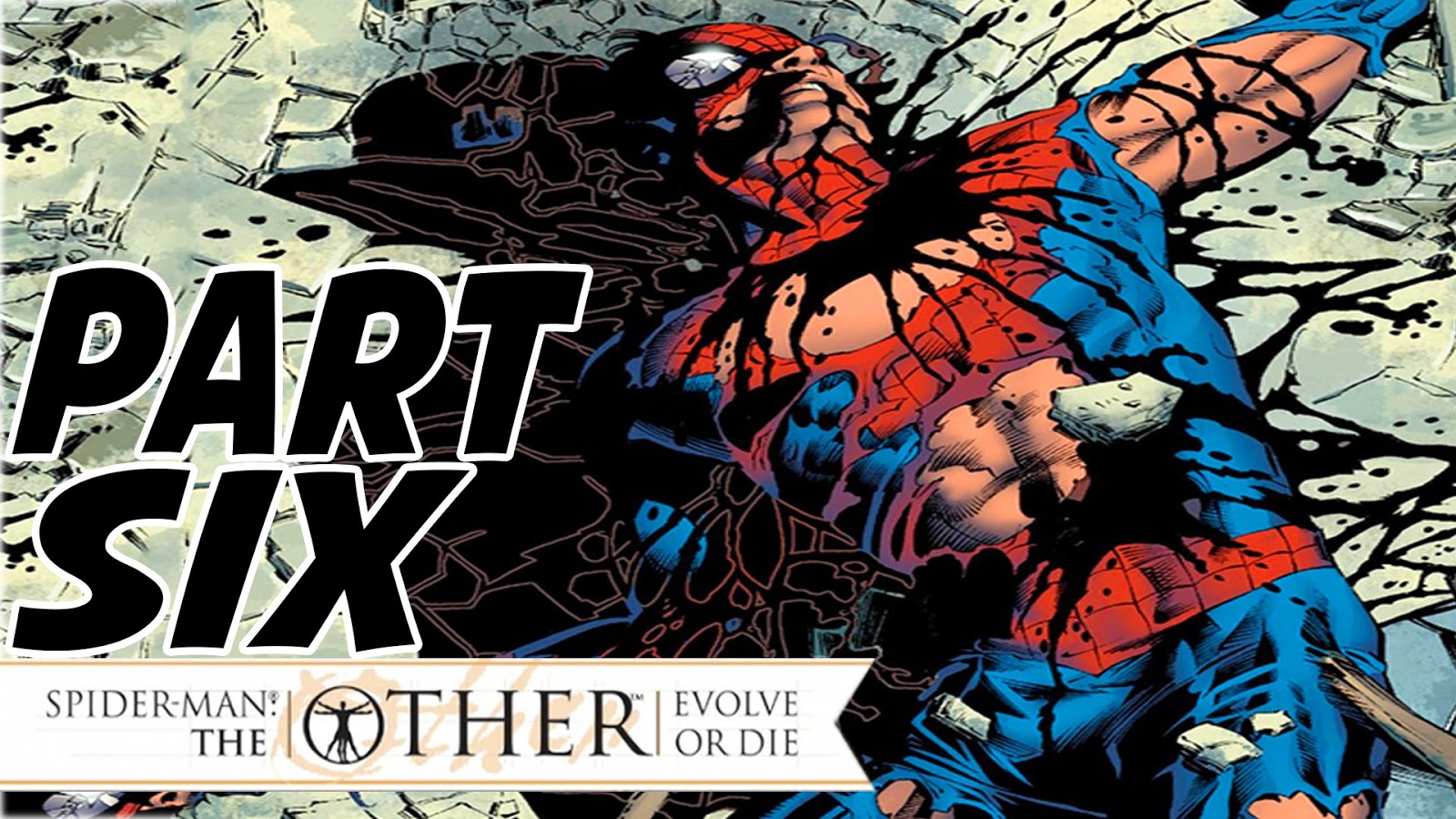
spider-man: the other

When J. Michael Straczynski began writing for Marvel Comics in 2001, he asked one simple but fascinating question: What if it was the spider, and not the radiation that gave Spider-man his powers?

That question, which made Spider-man fresh and new in a way he hadn't been for years, bears mixed fruit in "The Other: Evolve or Die." On the one hand, the entire concept of Spider-man as a totemistic hero, one chosen to serve as an avatar of the spider, is a fascinating idea. On the other hand, this is something Straczynski already has explored at length in the pages of "Spider-man," and it takes about two-thirds of the collection before the storyline actually presents us with anything new along those lines.

Written across four concurrently published Spider-man titles, "The Other" has Spider-man come face to face with his own mortality as a mystery ailment leaves him addled and weakened, and ultimately unable to defend himself against a murderous foe.

The story suffers from too many writers, but it shines its brightest when it focuses on the relationship between Peter Parker and his wife. There's a heart-wrenching moment when she confronts him with the survivor's guilt and subconscious death wish that drive him to be hero, for one. In another scene, written by Peter David, Mary Jane Watson-Parker watches a newscast helplessly as Spider-man fights Iron Man, and of course Spider-man's death scene, his fifth and easily best-written.

Like many other stories in a long-running title, the events of "The Other" no longer count in Spider-man's continuity and in this case at least, that's unfortunate. While it's not as strong as the earlier stories from Straczynski's tenure on "The Amazing Spider-man," "The Other" remains an engaging read.

Friday, July 04, 2014

swamp thing, volume 6

The final collection of Alan Moore's award-winning work on "Swamp Thing" finds everyone's favorite plant elemental trying to make it back home.

Volume 6 is less memorable than the previous volumes collected under writer Alan Moore's name. The first four volumes in particular focused pronouncedly were horror, environmental horror in particular. This anthology instead explores the genre of episodic science fiction as the Swamp Thing's spirit jumps from one planet to the next. As he goes Moore explores and offers up commentary on science fiction characters such as Adam Strange, Metron and a member of the Green Lantern corps.

Unlike the issues collected "American Gothic" storyline, these are essentially standalone stories and fairly straightforward fare. Loosely connected by his desire to return to the earth, the individual issues are not building up to any great conclusion, and in fact contain stories by other writers as well. Among these is Rick Veitch's issue with Metron and Darkseid, which in a few throwaway panel serves to foreshadow one of the storylines Veitch had planned for his own run on the comic.

This is not to say that the stories aren't good; Moore has always been one of the brightest lights in comic books, and in the 1980s, he was at the top of his game. It's clear from these stories that he was having fun, imagining unusual settings to place the Swamp Thing in, and along the way experimenting with the storytelling medium he was using. (There is one story told from the perspective of a sentient planet-size ship that encounters the Swamp Thing and traps him in her core for a brief time.)

But it's only after the Swamp Thing gets back to Earth that things begin engaging again, as Moore returns to his familiar environmental themes, and winds up his defining run on the series. And like every good writer does, he leaves the reader with something to consider on those themes.

While in space, the Swamp Thing discovered he could save a world from complete environmental collapse and ruin, and now on earth he is considering the possibility of doing the same here, until he realizes that humanity would simply squander the new Eden he gives them, and continue to blight it over and over again. It's better, he decides, to sit it out, and hope that humanity will wake up to its responsibilities on its own.

And on that, despite the horror we have seen over the last six volumes, Moore leaves us with the hope that we are willing to contribute, and the effort we are willing to make that hope real.


Copyright © 2014 by David Learn. Used with permission.

swamp thing, volume 5

I had never read much Swamp Thing until recently, when I finally got around to reading Alan Moore's classic take on the character.

As superheroes go, Swamp Thing really doesn't bring much new to the table. A brilliant scientist named Alec Holland, he was turned into a monster by a horrible accident in his lab in the Louisiana bayou that turned him into an intelligent mass of swamp life. It was a fairly ho-hum origin story until Alan Moore took over the title and started to explore the horror story potential around a being so literally plugged into the environment.

This, the fifth volume of Moore's seminal run on "Swamp Thing," marks a shift in the storytelling from the four previous volumes. Until now, "Swamp Thing" has been a comic showcasing environmental and social horror, covering topics like deforestation and overconsumption, nuclear and toxic waste, misogyny and domestic violence, and America's gun culture. Volume 5 is where it becomes a love story.

Comic books almost always have contained their romantic subplots, as the hero has a love interest that can't be fully realized for one reason or another. Superman loves Lois Lane, but she has a low opinion of Clark Kent. Ben Grimm loves Alicia Masters, but can't see her being with someone as misshapen and as monstrous as him. And not only is Abigail Cable married, the Swamp Thing is a superorganism of plants.

Here Moore offers a subtextual commentary on superhero relations as the authorities charge Abby with crimes against nature, prompting her to jump bail and flee to Gotham City. When the Swamp Thing discovers, he follows her to Gotham and ultimately brings the city to a halt and (naturally) comes into conflict with Batman until his lover is released.

This collection continues many of the environmental themes of Moore's earlier "Swamp Thing" stories, but it also delves into the psyche of an urban jungle and its powerlessness before the might of nature. Even as he tells the story of the love between the Swamp Thing and Abby, Moore shines his light into the emptiness of America's cities and the longing at the heart of humanity for a return to the Green and walking in step with nature once more.

As Batman later remarks, "I think all of us were awed by a love that could stop a city."

If you're looking for a superhero comic for your children, "Swamp Thing" isn't it. But if you want an intelligent story that gives you something to think about after you finish, you should read this, and the previous four volumes.


Copyright © 2014 by David Learn. Used with permission.

Saturday, January 12, 2013

'The Korvac Saga'

If I'm a fan of alternate histories and realities, and I am, the reason lies in a comic book Marvel Comics published up until 1984.

Narrated by Uatu the Watcher, "What If?" revisited some of Marvel's most iconic or successful stories, and showed how thy could have unfolded based on a single decision made differently. The initial run of "What If?" gave us stories, often by the talent behind the original story, of things like Peter Parker stopping the burglar and becoming a TV star rather than a superhero. Another story had Reed Richards wait for better shielding against cosmic radiation, with the result that he and his flight team never became the Fantastifc Four.

In one of of my personal favorites, Michael Korvac defeated the Avengers and pursued his dream of remaking the universe, taking out one being after another and adding their power to his own. As his power increased, the threat that Korvac posed alarmed more and more of the big hitters in the Marvel Universe until it reached the point that both he and the forces arrayed against him were unstoppable.

Backed into a corner, and unwilling to let go of his ambition, Korvac destroyed the entre universe with a single click of the Ultimate Nullifier. I want to stress that this wasn't cheap melodrama as later issues of "What If?" became. This was a logically structured story that progressed the only way it could. Even now years later, I still get a chill thinking about the way the it went.

In the regular Marvel Universe, where he did not destroy everything, Michael Korvac was the creation of Jim Shooter. He was one of many of the nemeses Shooter created for Marvel whose godlike powers were so tremendous that he was virtually undefeatable -- except of course, the heroes always manage to find a way, alternate realities excepted.

The Korvac Saga, as it is now known, first ran in 1978. Goaded on by that "What If?" story, I searched through comics conventions in my teens for individual issues in the series, and even managed to buy some. I never read the entire story until I finally got a collected edition this past week from PaperBackSwap.com.

It's disappointing.

In all fairness, comic books in 1978 had a younger readership than they do in 2013, and so you have to expect that they're going to focus on the adventure and cosmic spectacle more than on the humanity of their characters. That is particularly true for comics about superhero teams with rosters with legends like Captain America, powerhouses like Iron Man and Wonder Man, and the occasional Norse or Greek god.

But, to a 42-year-old who still finds something to enjoy in superhero comics, this comic did disappoint. There are too many clumsy asides to bring the reader up to pace on what happened last issue; too many people casually walking around in public or in the privacy of their own home in silly costumes; and too much melodrama to make sure we know just how powerful and menacing a figure Michael Korvac cuts.

And then there are other things that just feel odd. Never in my life did I expect to see Captain America and Iron Man squabbling like children, but that's a spectacle that awaits inside this volume. "It's my turn to be in charge and give the orders!" Iron Man whines. "But you're doing it wrong!" Captain America shouts, before punching him in the face. (I am not making that up.)

That's not to say the comic was awful, though, because it wasn't. If the story seems too juvenile at times, there are moments when the writer's wit shines through. There's the fashion show hosted by the Wasp, crashed by a supervillain wannabee wearing a suit made of brown projectile quills and calling himself the Porcupine. Or there's the moment when the Avengers realize, their special flight privileges revoked, that they will have to take a bus to Queens to save the world.

The story's got some of the great Marvel cliches, like a threat to the entire universe, but it also uses some of the storytelling techniques that have made Marvel Comics worth reading for so long, such as the use of a subplot involving the Collector that finally reveals its relationship to the larger story just as the subplot concludes. And of course, this is the story that gave us Henry Gyrich, the government bureaucrat every superhero is afraid of.

All told, I enjoyed the story for what it is, though I'd be lying if I said I didn't skim it at times. On the other hand, my daughters, who still love a good superhero romp as much I once did, have been enjoying it quite a bit.

Once they finish it, I need to turn them on to the story where Korvac wins.

Wednesday, March 12, 2008

ultimate iron man

So after a blitz of reading heavyweight books like "Who Wrote the Bible?" and poems like "The Song of Hiawatha," I turned my attention this weekend to the first "Ultimate Iron Man" trade paperback, written by Orson Scott Card.

Despite his multiple Hugos and Nebulas, I haven't really been able to get into Card's work. Because it was so highly rated, I gave "Ender's Game" a try, and then read "Speaker for the Dead" and "Xenocide," but it never really clicked for me. Still, when I saw that he had tackled Iron Man for Marvel's Ultimates line, I was intrigued enough to give it a try, once I could find a copy that I could read for free.
 
Most of the actual origin was the standard throwaway stuff you find in superhero comics: A prenatal Tony Stark inadvertantly was genetically altered so that every neuron in his body functions as brain tissue, making him unnaturally intelligent and regenerating his body  from any injury. He also has a subcutaneous bioarmor that makes him impervious to blunt force trauma. The downside is that he suffers chronic pain because the armor eats his body tissues, which are constantly regrowing. Yada yada yada.

The comic depicts the initial meeting between Stark and James Rhodes, and shows their relationship growing from mildly adversarial to actual friendship as equals. It also provides a reasonable explanation for Stark's alcoholism. Because he's always in some moderate pain from that bioarmor, alcohol when he discovers it at a cocktail party provides him with the first meaningful release from that pain in his life.

I really enjoyed Obadiah Stane.

If you're a comics geek like me, you will remember Obadiah Stane from what is probably the greatest Iron Man story arc ever told, back in the early to mid-1980s. Stane was a ruthless businessman determined to complete a hostile takeover of Stark Industries, which he accomplished by driving Tony Stark, a recovering alcoholic, to the bottle through a series of orchestrated personal disasters.

As the story arc unfolded, Stark gave the Iron Man identity to James Rhodes and ended up drinking himself from being the millionaire CEO and principal owner of a major industrial firm to a wino out on the street who nearly froze to death in a blizzard.

Card brought Stane into the story right from the start, even before Tony was born. In his treatment, Stane's parents are Zebediah Stane and the first wife of Howard Stark, Tony's father. Obadiah Stane and Tony Stark are born around the same time, to parents who had been married, and make natural dramatic foils for one another while they are still young. I've no idea how this has played out since in the Ultimate universe, but the storytelling potential is tremendous.

The Iron Man comic went back to the library today. But if I see some time that they have a second volume, I wouldn't be surprised if I were to pick it up for a light read too.

I need something to do between the heavier tomes I've been reading.


Copyright © 2008 by David Learn. Used with permission.


Friday, October 06, 2006

Mark Millar's 'Wanted' (spoilers)

Imagine a world with supervillains but no superheroes, and you might have an idea of what Mark Millar's "Wanted" collection is like.

No, scratch that. Millar's comic, published in a single volume in 2005 by Top Cow Comics, is something it takes a twisted genius to come up with. While most of the rest of us would imagine a world where supervillains run roughshod over everyone else and decent people struggle to eke out an existence, let alone a resistance, Millar instead has generated a world order run in secret by an Illuminati of supervillains.

Our guide to this hidden world is Wesley Gibson, a cube farm worker trapped in a miserable life until one day he discovers that his lost father has died and made him heir to a piece of that secret world.

This strange order of things arose about 20 years ago when the supervillains in the world united with a plan: Why not team up and get rid of all the world's superheroes once and for all, and proceeded to do so.

It makes sense, once you think about it, since every superhero has a score or more of regular supervillains on their roster, many of whom (for dramatic and storytelling reasons) are more powerful than the hero himself. Batman alone has the Joker, Two-Face, Mr. Freeze, the Riddler, Bane, Poison Ivy, the Penguin, Ra's al Ghul and the entire League of Assassins, Amygdala, the Scarecrow, Mr. Zzazz, the Calendar Man ... and on and on and on. Put them all together, and he wouldn't have a chance. Same goes for Superman and any other hero you can think of.

So that's what the supervillains did, back in 1986. They either killed the superheroes, or altered the timeline so that they weren't superheroes anymore -- they were actors who had played superheroes on TV shows or in the movies, and so on. It would be as though Christopher Reeve actually were from another planet, or Adam West really were the world's greatest detective -- and yet both men were unaware of this.

The supervillains, with their foes out of the way, now ran the world, from the behind the scenes. Any time they committed a crime, they covered it up through their vast network of controls.

Once Wesley Gibson has been fully inducted into this new world, and the readers with him, the action begins. Not every supervillain is content to rule the world if no one knows about it. What's the point in ruling the world if you don't get to frighten people? So a rift emerges between the "good" supervillains and the "bad" ones, as the more psychotic ones step out of the shadows, neutralize their colleagues who have been holding them back, and everything starts to go crazy again.

Best of all is the ending, which I won't ruin for anyone who hasn't read the comic, but it's got a brutal in-your-face message to people who hate their jobs, feel their lives suck, and spend $20 picking up a trade paperback.

It's a great idea for a comic, and there are some genuinely brilliant scenes in the comic, but this isn't one I'll be reading again. It was just too crude: the sexually denigrating remarks, the runaway potty mouth, and the struggle between amoral characters and their nihilistic foes drained the book of a lot of its pleasure.

Even the pleasure and wit that do survive are tainted by the foul language. Naming characters "Fuckwit" and "Shithead" is the sort of locker room humor that schoolyard bullies enjoy; it's not the sort of thing you hope to find in your reading material, either casual or serious. And by the time the comic was over, Millar had dropped so many F-bombs, it was amazing there was anything more than a smoking crater left of the comic.

Perhaps this was meant to show how tough the characters were, or how uncouth; but without some sort of counterweight, all it left me with was a feeling of emptiness -- the story was clever enough that better writing would have made it more memorable and worth reading again.


Copyright © 2006 by David Learn. Used with permission.


Thursday, October 05, 2006

man of steel

If you've ever wondered it would be like to see Superman through the eyes of his worst enemy, this could be your chance.

Written by Brian Azzarello and with illustrations by Lee Bermejo, "Lex Luthor" provides a rare look at Superman from the perspective of his greatest enemy. It gives us an even rarer, sympathetic look at Lex himself. For characters as storied as these two, anything that looks at them in a fresh light is going to be worth looking at. This particular look cost $13 when I bought it.

Let's be fair. Superman is not exactly the most interesting superhero to read. He's invincible, he can fly, he can lift mountains, he can freeze you with his breath, hear clouds scrape together, watch cells divide, see things thousands of miles away, burn things with his heat ray vision, and see through solid objects.

His only vulnerabilities are to magic, kryptonite and fatigue poisons. That means any time he's fighting a supervillain, the fight is going to end quickly or destructively, and the action sequences in his comics are going to be melodramatic and juvenile. I recently borrowed a collection of the regular Superman titles from the library and never finished. It was awful.

By the same token, Lex Luthor usually isn't a compelling villain. He gets solid treatment from Neil Gaiman in "Black Orchid," and from time to time elsewhere as well, but he's usually little more than Richard III on Machiavellian steroids. He schemes and plots, and he avoids getting caught, because that's what he does. It's his function. Lex Luthor just enjoys power and wants to crush everybody beneath his feet because he can.

The best treatment I've ever seen of the Superman legend technically wasn't even Superman but Hyperion, a pastiche published by Marvel Comics. The second probably would be Mark Waid's treatment in "Kingdom Come." In both cases, what made the Superman character compelling was the writer's exploration of his interactions with the rest of the world, either the superpowered community in "Kingdom Come," or the nonpowered humans of "Supreme Power."

Similarly, John Byrne gave Lex Luthor probably the most compelling characterization during his run on "Man of Steel" in the 1980s. At one point in that run, Luthor's detectives and agents have assured him with almost total certainty that Superman is none other than Clark Kent, a reporter for the Daily Planet. Luthor, rather than using this discovery to crush his adversary, fires everybody from the project because it's so idiotic to assume that a man as powerful as Superman would be content to work as a newspaper reporter.

Azzarello builds on the foundation Byrne laid, by showing us exactly how Luthor views himself and Superman. In this reading, Luthor sees Superman not as a savior, hero or inspiration to the people, but as übermensch -- an alien of incalculable power, who is posing as a hero but who in fact limits human potential and who could at any point decide to rule humanity openly.

This isn't exactly new material. Writers established years ago that Luthor considers Superman a danger, believes himself to be the only person to see the danger clearly, and even imagines that he'll be hailed as a hero after he has bested Superman once and for all. The difference is that every time we see Luthor expostulate on this position, we see him driven by jealousy and fear.

Here Azzarello shows us Luthor as he sees himself: a decent man who offers humanity hope, who treats his janitor as an equal, with respect; a man who takes interest in his employees' children and their welfare; and who is welcome to sacrifice whatever it takes to show the world what a menace Superman really is.

And when he casually ruins lives, threatens a labor representative with death, and manipulates other people into committing atrocities, we see hints that it bothers him.

I enjoyed the nice touches that round out Luthor, who insists on calling his janitor by his first name, the feeling guilt and grief over the consequences of his actions, and the evident respect he has for Alfred Pennyworth and his commitment to Bruce Wayne. And I appreciated that we never got Superman's perspective on the story, but for one sentence.

But at the same time, I couldn't help but feel there were a few unexplained and needless additions to the story. Sure, it's nice to see Lex Luthor matching wits with Bruce Wayne as one businessman to another, but there's what appears to be a fight between Batman and Superman that's never explained, a decision Wayne makes to share Wayne Technologies research with Lexcorp, and an entire fifth of the comic that goes in what I presume is supposed be thematic rather than chronological order, with the result that I've read it five times and still don't quite understand the order of events or its relevance.

Despite its shortcoming, the scope of this sympathetic portrayal of Luthor is unprecedented in my experience. For that reason alone, this comic is worth reading and it deserves to be included in any Luthor bible that D.C. compiles.


Copyright © 2006 by David Learn. Used with permission.


Wednesday, March 01, 2006

'half a life'

I have found a hero in Gotham City, but it's not Batman. It's Renee Montoya.

Montoya has been a detective in the Gotham City Police Department since 1992. The daughter of Dominican immigrants, she works in the department's major crimes unit, where she helps to investigate crimes by Gotham's costumed criminals like the Joker and Mr. Freeze. And she's the central character to "Half a Life," a collection I just read twice after borrowing it from the local library.

I love my library.

"Gotham Central" is part of that relatively new genre of comic books set in the world of superheroes, but with superheroes and their colorful sparring partners used as backdrops rather than as the star attraction. The main story is the human drama of the people who inhabit the same world as the capes.

The art is incredible. For the bulk of "Half a Life," which incorporates relevant single issues from other Batman titles, the art makes good use of light and shadow, smooth lines, rugged lines, and color. It's got a gritty feel to it, which is appropriate, since it's about Gotham City, the seedy underside of DC's urban world.

But good as the art is, it's the story itself is what makes the collection a must-have. It starts out with an issue printed just after "Cataclysm," the Batman-event earthquake that rocked Gotham City in 1999. Montoya is out working with emergency crews trying to locate and rescue quake survivors trapped beneath rubble, and finds herself working with Two-Face.

Two-Face is former District Attorney Harvey Dent, horribly scarred on half his face and given to a pathology that leads him to cede major decisions to the flip of a coin, one side of which is defaced. If the coin comes up heads, he's your friend; if the defaced side comes up, he probably will kill you. Whatever he does do, it won't be pleasant.

Every time someone asks for help, Two-Face flips the coin. To Batman, the risk of the coin landing wrong would be too high, and he would take Two-Face down rather than face that risk. But Montaya is not Batman. She is a cop who finds needs Two-Face to help with the rescue effort. She has one bullet in her gun, and she is prepared to use it, but every time Two-Face flips the coin, it comes up heads and he helps. It's impossible but it keeps happening.

Montoya realizes that she understands the coin, and when Batman appears and tries to stop Two Face, she uses that understanding to keep Two-Face focused on the rescue effort and to keep Batman from interfering. That understanding reaches Two-Face in a way I don't think I've ever seen him reached before, and he wants to reach back.

Unfortunately, the only way he knows how to do that is through his coin, and the law of averages dictates that it has to come up tails the same number of times it comes up heads.

As "Half a Life" progresses, the story becomes about Montoya's own personal duality, an identity that she keeps secret, and the way that Two Face's reliance on the coin forces the two halves of her life out in the open and utterly destroys them both. It's a brutal process, and you can see the toll it exacts on Montoya's family, her friends, and her partners at the department, but especially on her. It hurt to read this comic, it was that well written.

I'm not going to reveal the nature of Montoya's secret, except to say that it's handled well. The only complaints I have are that the secret is a little stereotypical, given her career; and that I think Batman, while he makes a great part of the background, makes a lousy deux ex machina. But the story is handled extremely well and honestly.

It's no wonder this received the 2004 Eisner Award for Best Story. It is fantastic.

My library has saved us a small fortune in books and videos over the past year, and trips like this one have let me read about $60 worth of graphic novels and determine that I'd really like to own only $15 worth of them. The comic shop isn't nearly that understanding.

The other comics I borrowed from the library this trip include a collection from Mark Waid's run on "Fantastic Four" where they visit God, best skipped; and his series "JLA: Year One." That one at least is a decent, fast-paced comic with some real character development of the classic Silver Age characters and team, but it's worth reading only once, and will go back to the library today.

"Half a Life" stays until its due date, and then it goes on my list of must-haves.


Copyright © 2006 by David Learn. Used with permission.


Thursday, May 05, 2005

kevin smith's 'quiver'

You know, I've never been a tremendous fan of Green Arrow.

As superheroes go, he's not particularly remarkable. Oliver Queen is another billionaire playboy industrialist -- like Tony Stark, like Bruce Wayne, like Daniel Rand and like Marc Specter, to name a few -- who uses his fortune to finance a career of vigilantism. His schtick is that he's a peerless archer, a modern-day Robin Hood.

Queen has no superpowers, but because of his money he can buy trick arrows, like Hawkeye. Because he's in the DC Universe, Green Arrow usually associates with the Justice League, although I have vague memories from when I was younger of a title that he headlined specifically with Green Lantern.

I've been reading the collection of  Kevin Smith's "Quiver," and it's enough to spark my interest in the character.

For starters, he is easily the most radically liberal superhero I can think of. He is the only superhero whom I can picture actually calling the police fascists, chewing out the City Council for closing a youth center, and even telling off Aquaman for having elitist royal attitudes.

But beyond that, this comic is just a solid introduction to the character and his history.

Oliver Queen died after the events of "Zero Hour," a 1994 DC companywide event that grew out of the death of Superman two years earlier. Superman's death was followed within a year by the appearance of four separate heroes each of whom might be a resurrected Superman. One turned out to be Kon El, his clone; the second, John Henry Irons, the superhero Steel; the third, Superman with a mullet; and the fourth, the supervillain Cyborg.

During this period of four Supermen, Cyborg destroyed Coast City, where Green Lantern lived in his civilian capacity as Hal Jordan. Driven insane with grief, Jordan tried to use his power ring to remake the universe so that Coast City was restored. In the end, it was Oliver Queen who killed his friend.

Queen himself died not long after on another adventure, and into his shoes stepped his son Connor Hawke, himself a skilled archer but one who did not use gimmicks like boxing glove arrows.

The mystery of "Quiver" is why Oliver Queen is alive again, and to an extent whether he even really is Oliver Queen. He has no memory of Coast City's destruction, cannot believe that Hal Jordan is dead, and is stumped when he first sees a cell phone. "What, do you think you're Batman?" is essentially his reponse.

It's this search for an explanation that drives the comic, and the reactions other members of the Justice League have to his unexpected return that make it interesting. Batman not only is suspicious of Queen's apparent resurrection, he provides some of the most cutting commentary about how derivative a character Green Arrow is, down to the Arrowcave and Arrowmobile, and even Arrowmobile.

The comic's momentum falters as the explanation for Queen's return begins to emerge, though it recovers as the story works toward its conclusion. It's a fun read, but it does beg the question: Is it really necessary to bring a hero back from the dead?

One of the things I've liked about D.C. Comics is that they haven't been pulling these penny-a-piece resurrections, except with Superman. The roster of dead superheroes, and the succession of their sidekicks and namesakes, has given the DC Universe a sense of history that Marvel lacks. Not only was Oliver Queen dead and someone else assuming the mantle of Green Arrow, there was a new Green Lantern in the Justice League after Hal Jordan's death, and a new Flash as well.

No one seriously expects members of the Fantastic Four to perish in the line of duty, or the Avengers; and if a hero does die, you know they'll be back soon enough. Even the villains recover from death. The Green Goblin had been dead for more than 20 years before he came back at the end of Marvel's ill-advised Clone Saga. That makes the menace of death much lower and the theatrics of superheroics much cheaper. There's no risk to what they do.

But in DC Comics, the death of Oliver Queen until now meant that there were real stakes for Connor Hawke's efforts with the Justice League. The fact that Kyle Rainer was the most recent and last of the Green Lanterns told him that he had reason to be afraid. Jay Garrick was still alive and powered as the Flash, but he was also in his 60s or early 70s. Wally West knows not only that Barry Allen died saving the universe, but that as the Flash he's responsible for a legacy that goes back before he was born.

Bringing heroes back from the dead cheapens their sacrifice, and erodes that sense of a grand and proud history. Kevin Smith has taught me to appreciate Queen as a character, but not that he was worth bringing back from the dead.


Copyright © 2005 by David Learn. Used with permission.