Friday, August 08, 2014
spider-man: the other
That question, which made Spider-man fresh and new in a way he hadn't been for years, bears mixed fruit in "The Other: Evolve or Die." On the one hand, the entire concept of Spider-man as a totemistic hero, one chosen to serve as an avatar of the spider, is a fascinating idea. On the other hand, this is something Straczynski already has explored at length in the pages of "Spider-man," and it takes about two-thirds of the collection before the storyline actually presents us with anything new along those lines.
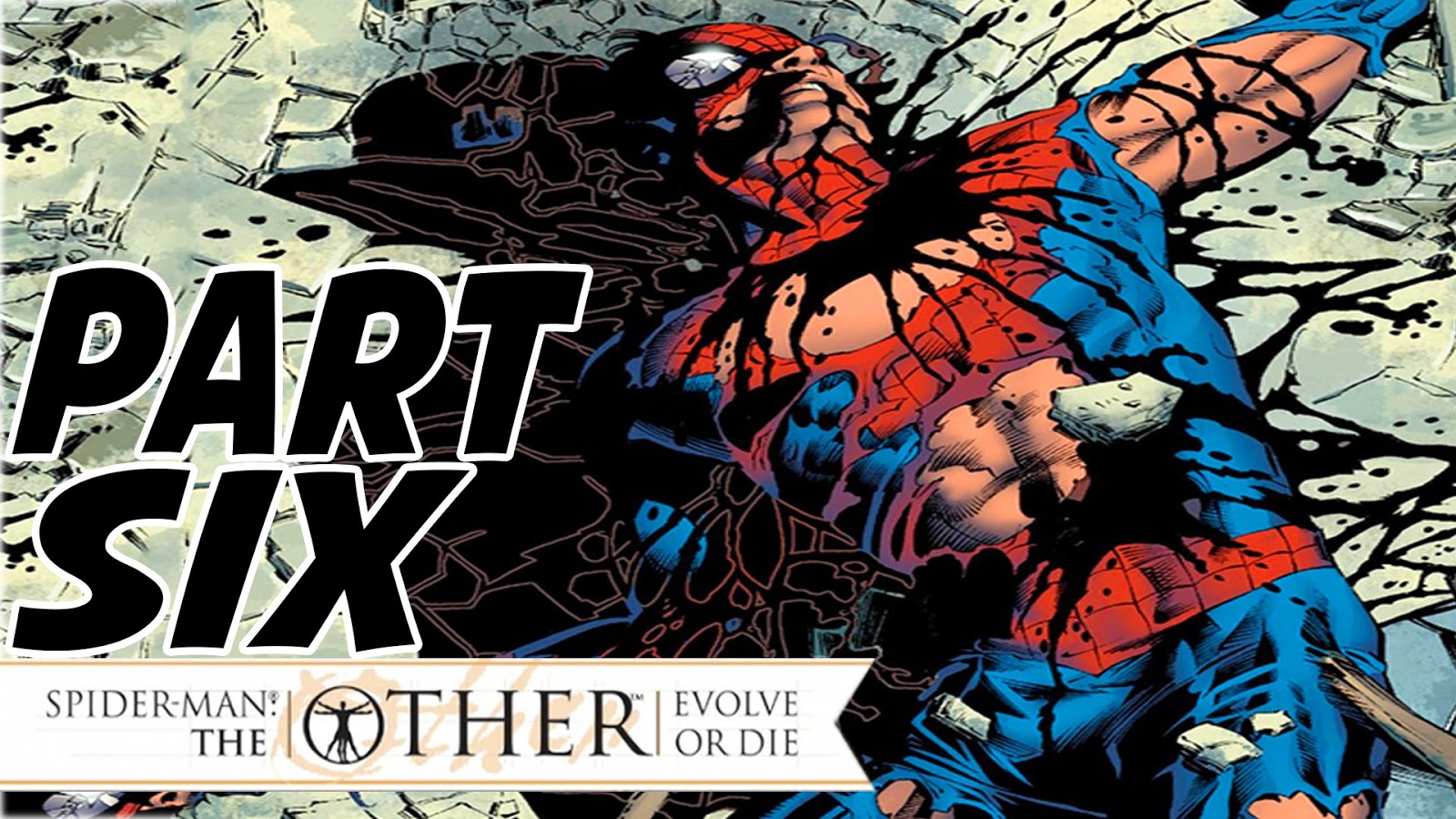
Written across four concurrently published Spider-man titles, "The Other" has Spider-man come face to face with his own mortality as a mystery ailment leaves him addled and weakened, and ultimately unable to defend himself against a murderous foe.
The story suffers from too many writers, but it shines its brightest when it focuses on the relationship between Peter Parker and his wife. There's a heart-wrenching moment when she confronts him with the survivor's guilt and subconscious death wish that drive him to be hero, for one. In another scene, written by Peter David, Mary Jane Watson-Parker watches a newscast helplessly as Spider-man fights Iron Man, and of course Spider-man's death scene, his fifth and easily best-written.
Like many other stories in a long-running title, the events of "The Other" no longer count in Spider-man's continuity and in this case at least, that's unfortunate. While it's not as strong as the earlier stories from Straczynski's tenure on "The Amazing Spider-man," "The Other" remains an engaging read.
Monday, December 31, 2012
ultimate spider-man
Last year, Marvel Comics announced it was introducing a new character to fill the shoes Spider-man. This new web-swinger is named Miles Morales, and unlike Peter Parker, he's not white. He's half-black and half-Hispanic, and represents part of Marvel's overall shift at Ultimate Comics to increase the racial and ethnic diversity of their superheroes.
Predictably, people were upset about the change when it was announced. People complained that Marvel was getting rid of the traditional Spider-man, and accused the company of kotowing to political correctness.
A few things surprised me about this. First is that Miles is not replacing the Spider-man who Stan Lee and Steve Ditko created in 1962. He's replacing the Spider-man whom Brian Michael Bendis created in 2000 for Marvel's Ultimate Comics line.
Second is that even if he were, so what? It's not like there is a dearth of white superheroes, and death in comic books is about as permanent as a haircut. If Marvel can create a superhero who speaks to the experience of its readers of color, I'm all for it.
Spider-man as a character has grown stale because of his pop culture success. He's not allowed to age, to marry and have children or otherwise significantly change, because the editorial powers at Marvel would rather milk their cash cow until it goes dry than risk killing it. Reinterpreting the character as an inner-city person of color rather than as a white teen from Queens is bold and opens up new avenues of storytelling.
What amazes me is that people still are upset about it, more than a year later. Two people at the comics shop the other day criticized Miles when they saw I was buying my daughter a collection of Ultimate Spider-man that included Peter. A friend of mine complained about him last night. Hel-lo, people! Miles rocks.
Miles has a lot of the traits that have always made Spider-man a hero, aside from the obvious spider powers like strength, spider-sense and sticking to walls. In many ways he's every bit as reluctant and outcast a hero as Peter is.
Peter first tried to make money with his powers, and only realized how he was wasting his gifts when a burglar he had failed to stop earlier, later killed his Uncle Ben. Miles used his powers to save some children from a fire, but was so unsettled by the experience that he didn't use them again until after Peter had died.
But the defining characteristic, the one thing that makes Miles stand out from Peter and makes him worth reading is this: He's not Peter. The Ultimate Peter Parker is dead, killed in a battle with the Green Goblin, and remembered by the entire city as a hero.
Miles is trying to honor Spider-Man's memory, but it's going to be ages before he's able to step out from under the shadow of his predecessor and gains legitimacy in the eyes of the New York. (And from some comic book fans, obviously.)
And just as importantly, Miles knows that he can die. One Spider-man already has, and unlike in the mainstream Marvel Universe, the Ultimate Universe doesn't seem to have a revolving door on heaven.
If Miles were simply a case of brown-washing -- if he were from Queens and had the exact same origin story and personality as Peter -- I'd probably agree with my friend who dissed Miles before I explained his story to her. But he's not a black Hispanic superhero for the sake of having one, and when Marvel debuted him, they didn't just create a black Peter Parker. They created a new character, one worth reading for his own sake, and one worth starring in his own movie some time.
He's also a racial minority, a bright kid from a neighborhood a lot worse than the one Peter Parker grew up in. As far as I'm concerned, that's just icing on the cake.
Miles isn't just a black Spider-man. As far as I'm concerned, he is Spider-man, hands-down: fresher and more fun to read about than Peter Parker has been in years.
Copyright © 2012 by David Learn. Used with permission.
Tweet
Sunday, July 06, 2008
comic books as literary cycles
There's a never-ending parade of bad guys who want to rule the world, rob banks, and even nettle specific heroes. They're faced with, and invariably defeated by, a smaller but also never-ending parade of good guys dressed just as atrociously who got their powers in the same improbable ways (chemicals, radiation, genetic flukes or alterations, and aliens).
The stories fall into predictable routines. Maximus has retaken the throne of the Inhumans from his brother, Black Bolt, the rightful monarch, and sent the royal family into exile. Galactus is going to eat the Earth unless his cosmic hunger can be averted. A psychotic madman is terrorizing Gotham City, and Batman has to find him.
By the time you turn 16 or 17, you start to realize that even the comic books about interesting heroes usually aren't worth buying, and so you start to look for specific authors, who you realize can make a comic book about tomato soup interesting, authors like Mark Waid, Neil Gaiman, J. Michael Straczynski and Brian Michael Bendis. Sometimes you even hear about legendary and definitive runs from years past, like Frank Miller's "The Dark Knight Returns," "Batman: Year One" and "Daredevil: Born Again"; Walt Simonson's run on "The Mighty Thor," Tom DeFalco's stint on "Amazing Spider-man," or Alan Moore's legendary "The Saga of the Swamp Thing."
But if you keep reading the same title long enough, you're going to notice some recurring problems. For one thing, no one gets older. Franklin Richards has been 5 years old for more than 30 years, even though the Fantastic Four surely have celebrated his birthday a few times in there.
For a second thing, some storylines seem to keep repeating. How many times has Galactus threatened to eat the Earth after the immortal Lee-Kirby story where he was thwarted and pledged never to try again? How many times is Congress going to consider a superhero registry, or will mutants face the biggest threat to their existence ever?
And for another thing, the long-term storyline is about as clear as a pile of mud three feet deep.
Peter Parker first became Spider-man in August 1962, when he was 15 years old. In the more than 40 years since then, he's aged only to his late 20s, with his story being told in as many as four separate titles at a time. It's just too much storytelling to pack into thirteen years of chronology.
But the lion's share of the blame for the confusion comes from something else: the change in creative teams, which usually comes every five years or so. Attempts to keep the chronology clear usually just make things more confusing. Take Thor for example.
When Thor debuted back in 1962 in "Journey into Mystery," he was pretty much just another guy in a cape with superpowers. He could control the weather, throw a hammer that returned to him like a boomerang, he was superhumanly strong, and he could fly.
Thor moped around for Jane Foster, a nurse who worked for his alter-ego, Donald Blake. Rather like Clark Kent's relationship with Lois Lane, Blake loved Foster, but she had no time for him, and instead preferred his alter-ego. As the comic continued, there were occasional nods to Thor's roots in Norse mythology, but it wasn't anything big, and it got mixed up in a big potpourri of other myth that included the Greek pantheon too.
Walt Simonson came onto the scene in the 1983 and gave the book a massive overhaul. On the first page of his first issue on the title, he began by having some unknown being destroy a star and begin forging a weapon from the core of the star. By the end of the issue, he also had introduced a new character, Beta Ray Bill, whose claim to the power of Thor was as strong as Thor's own.
As the story unfolded over the next several issues, Simonson drilled deep into the rich tapestry of Norse myth, firmly establishing Thor as a member of the Norse Aesir, giving his readers a crash course in that mythology and the stories the Vikings used to tell. As he did this, he gradually racheted up the tension until you realized that the weapon being forged from the core of that exploded star was the flaming sword that Surtur would use to set in motion Ragnarok, the Twilight of the Gods, and destroy the Nine Worlds.
By the time he had finished his story, some five years later, Simonson had revoked Thor's identity as Donald Blake and given him a new alter ego as a construction worker named Sigurd Jarlson. He got rid of Odin as head of the Norse gods and replaced him with Balder, destroyed the rainbow bridge Bifrost, and established a truly stunning cast of supporting characters.
It was tremendous, it was inspiring, and for me at least, it launched an abiding love for Norse myth. Stan Lee and Jack Kirby gave us a superhero named Thor. Walt Simonson reminded us that Thor was a Norse god, and gave us the definitive run on the title in the process. If the comic had ended there, it would have been enough.
It did not end there.
Tom DeFalco, who had done an excellent job on Spider-man in the 1980s, took Simonson's place, and turned it into ... I don't know what. In the few issues that I bought and read, Thor accidentally wandered into deep space, where he squared off against the Celestials. He started fighting with Irish and Egyptian deities, and became less interesting and distinctive a character.
Changes Simonson had made to the character -- having him grow a beard and wear armor, making him look more like the mythological Thor -- were dropped immediately. Odin came back not long after. Last I heard, Thor was back to being Donald Blake, too.
In other words, in terms of continuity, Simonson's run on Thor might as well not have happened. In fact, a later writer revisted the whole Ragnarok storyline, although he apparently wrapped it up by having Thor change history at the end of the story arc, so that it had never happened.
That sort of thing happens a lot in comic books, and if you're a serious fan of a character or even a particuarly well written story, it can be frustrating to see it reduced to just another episode in the life of the character, with no lasting effects. If Norman Osborne impaled himself on his goblin glider in the 1970s, why is he bedeviling Spider-man again 25 years later?
If Mysterio died at the conclusion of Kevin Smith's Daredevil story, why is he tangling with Spider-man six months later? If the Outsiders knew Batman's secret identity five years ago , why are they so shocked when he reveals it to them now? And how many times does Peter Parker's Aunt May have to die? (Or Captain America, for that matter. Steve Rogers blew up at the end of WWII, he died when his body rejected the Super Soldier serum in the 1990s, he was killed by Onslaught in 1997, and most recently, a sniper shot and killed him.)
A lot of it's because these characters are so old, and so loved by such a number of people. Each time a new writer comes in, she has a choice: keep her predecessor's supporting cast in place, leave the hero in the same general situation as for the last 30 issues or so, or return a more familiar starting place.
Most writers prefer the second choice. So you get some really convoluted stuff, like "That wasn't Aunt May who died; it was a genetically altered actress impersonating her!" Or "The Iron Man you've known has always been in the service of Kang. Now we'll bring in another one from a different timeline!" Not surprisingly, fans do get sick of it and stop reading.
In the past several years, straightforward storytelling has taken a beating at both DC and Marvel as heroes long dead have returned to life. The new Captain America is none other than James "Bucky" Buchanan, Rogers' partner in WWII. Oliver Queen, the original Green Arrow, came back from the dead, as did Hal Jordan and the entire Green Lantern Corps. DC Comics even restored its entire multiverse in "Infinite Crisis," ending nearly 20 years of a single, straightforward continuity with one DCU.
This sort of thing aggravates me, because I liked it better the way it had been. DC's continuity, prior to "Crisis on Infinite Earths" was a bewildering mess, with storylines taking place on parallel earths, and even crossing over annually as the company lurched from one crisis to another.
The new continuity under Jeanette Kahn eliminated that confusion and gave the impression of history, with one generation of heroes making way for the next generation, so that by the present time, Wally West was the third hero to bear the name Flash, Kyle Rainer was the third to be Green Lantern, and so on. The history made the DCU more realistic, and more entertaing to visit.
But of course, other people liked it the other way. And because opinions run so strong on these things, it's not surprising that the policy should change as one group gains dominance and the other loses it. Is Lex Luthor a mad scientist, or a corrupt businessman? Did he know Clark Kent as a boy in Smallville, or did they meet for the first time in Metropolis? It depends who owns the story.
The same is true of Marvel's treatment of with Peter Parker and Mary Jane Watson. The two of them were married about 20 years ago, and ever since then, fandom has been evenly split on whether it's a good idea or not. In the time that they've been married, Mary Jane was killed in a terrorist attack (it turned out she was kidnapped before the attack), and she's left Peter. (They reconciled.) Most recently, their marriage was retconned out of existence via a deal with Mephisto to save Aunt May.
I'm firmly on the side of the marriage, and I'm not alone. It keeps boiling down to a question of whose vision of Spider-man prevails at any given time.
There is a simple way to deal with this mess. View it as a cycle of literature, handed down from one storyteller to another. Never mind questions of continuity, and how the stories hang together. Consider each storyteller's take on the character as a separate contribution and interpretation of the character.
Most of them suck, but some are incredible -- Mark Waid's "Birthright," for instance, in which he depicts Superman as an outsider who must earn the trust of Metropolis, or JMS' first several issues on "Amazing Spider-man," where he reinterprets the hero around totemistic lines and makes Peter a teacher instead of a photographer, or Bendis' stellar run on "Daredevil."
It doesn't even matter if they conflict with one another. "Birthright" differs widely from John Byrne's "Man of Steel," but they're both excellent reinterpretations of Superman's origin. They're part of a cycle of literature, not a continuing story. That's much easier to stomach, and sometimes, the storytellers even surpass themselves.
And that's what makes them worth reading.
Copyright © 2008 by David Learn. Used with permission.
Tweet
Monday, November 06, 2006
Remembering my time with Easton Assembly of God
I joined the Assemblies of God the summer of 1990, while I was still a student at Lafayette College, and remained a member until late 1996 or early 1997. I wasn't just a member in good standing, either; I got involved in children's church ministry almost immediately, and resumed that involvement in mid-1994, when I returned from Haiti, until I left to join Beloved at her church on College Hill.
There were a few bumps in my relationship with the church, but on the whole my experience and my memories are positive ones. They perhaps are exemplified in the working relationship I had with one person in particular.
Cami Sweeney became the head of the children's church ministry not long after I returned from Haiti and remained so when I left. A graduate of North Central Bible College, Cami had grown up in Easton Assembly of God and had fairly conservative social values and doctrinal beliefs.
We had a working relationship that was based on a mutual appreciation for each other's knowledge, ability and enthusiasm for children's ministry. We each brought a solid knowledge of Scripture, doctrine and church tradition to the table. We didn't always agree on how to interpret it, but rarely found anything worth fighting over. (And when we did, we always apologized sooner than later.) ; She appreciated my experience on the missions field, and I appreciated hers at Bible college.
We also both were appalled at the low quality of material we were given to run the children's program with, each believed we could do better, and worked in tandem or by ourselves to do just that. Puppet sketches, a cast of ridiculous characters for object lessons and Bible verse illustration, sermons, and basic silliness flowed from our combined imaginations for session after session. We talked at one point about seeing if we could find a publisher for our curricula, but nothing ever came of that, sadly. I still think we could have done it.
But for all that, Cami couldn't understand why I would presume to teach children's church without ever having spoken in tongues myself. She couldn't understand why I saw nothing wrong with Spider-man (after all, she said, he walks on walls!) or even with Santa Claus, and was in complete disagreement when it came to my frequent disdain for the Christian subculture we both inhabited.
We got along well — in hindsight our close work together made her in some ways one of my best friends at the church — but there were times we were an utter mystery to one another. Cami loved Frank Peretti's novels "This Present Darkness" and "Piercing the Darkness." I thought they were crap.
When she told me how much she hated "The Oath," in part because it had a dragon, I told her I valued her recommendation, and immediately went out and bought a copy on sale at the Evil Bible Bookstore. It was a page-turner, and easily his best work to date. When I told I had thought it was pretty good, she laughed and shook her head in disbelief.
The last two falls I was there, Easton Assembly of God hosted hell houses, an alternative to Halloween that's meant to scare people into faith by showing them the horrors of hell taht await drug users, gay people and Democrats. Pastor Webber urged members to invite their non-Christian friends, neighbors and relatives to them. I made fun of the concept mercilessly. "Invite your non-Christian friends, neighbors and relatives! They won't become Christians, but at least they'll stop talking to you.") Cami of course disagreed, and I usually let it go.
I finally left Easton Assembly of God at the end of 1996 when it became obvious that the church and I viewed the faith from essentially incompatible places -- I prefer to scrutinize church practice in light of established revelation, while the church was big on experience and urged critical thinkers of myself to stop questioning and just "have faith"-- and because of various other things, like the pastor's fixation on money.
Still, the church and the denomination continue to hold a place in my heart, and I remember people like Cami fondly, even though I'm sure I bewildered the heck out of them.
Saturday, January 07, 2006
merchandising as an art
And really, he has a point, doesn't he? Would Calvin be so quintessentially boy if you could find him on mouse pads, coffee mugs and what have you? Would Hobbes be uniquely Calvin's pet tiger if every child in the universe could have owned one just like him? Of course not. And hasn't Calvin's image been tarnished by the unauthorized merchadise? He's been locked into Adam Sandler juvenile humor mode by all those bootleg window stickers that show him peeing on other car manufacturer logos. Lost in there is the real essence of a boiy, his imagination, his other forms of mischief, and his poignancy. In the same way, the majesty and grandeur of Aslan has been reduced because of my daughter's ability to play with him and make him do whatever she wants. "Not a tame lion," indeed.
I've always have been impressed with Watterson's commitment to the sanctity of his art. Both he and the Christianity Today writer make an excellent point about how the medium is part of the message, and using the merchandising medium affects the message in the other media as well.
Things like this make me glad that we don't get TV signals in our house. There's a lot of merchandising the girls just aren't aware of, and that makes things a lot easier. We're not overrun in junk like we would be, and the experience of a movie or book isn't cheapened as easily or as quickly for them as it is for their peers.
It's like Evangeline with Spider-man. She has two sets of sheets, a T-shirt, a sweatshirt, a backpack, a winter hat, a place mat, sneakers, a video game plug-and-play set, and at least one coloring book. There's probably more stuff I'm not even thinking of. She's seen the movies and even read a couple comic books, but a lot of her association with Spider-man has been tied up in the merchandising and the times she's had to assert her right to like Spider-man at school, where her classmates have told her that Spider-man's just for boys. Spider-man is a material asset to her, rather than a moral story about responsibility and how a moment's inaction or refusal to care about someone else's problems can lead to real problems of our own.
Monday, December 26, 2005
an arachnophile christmas
This was the year Christmas at our house was bitten by a radioactive spider.
Although the day had highlights besides the presents, and even though there were presents that generated more enthusiasm than these, there was no doubt that this year, Spider-man did very well at our household. Virtually everyone received at least one present with everybody's favorite wall-crawler on it.
The big winner was Evangeline, who has been carrying the Spider-man torch high enough for three children her age ever since last Christmas, when I received a handful of Spider-man trade paperbacks. Evangeline's favorite present this year was the "Matilda" movie-and-book combo from her New York aunt and uncle, but she spent the entire day wearing a new Spider-man winter hat and a pair of Spider-man slippers. Other web-spinner gifts included a Spider-man place mat for meals, a pair of Spider-man pajamas, and a Spider-man comic book intended to introduce him to young readers.
Rachel fared less handsomely with the Spider-man gifts -- her fan identity is less known that Evangeline's -- but even she got the place mat and a pair of slippers. Thankfully, the slippers are noticeably different. Evangeline's pair, which Rachel bought for her, incidentally, have little Spider-man heads that poke up and look forward from a vantage point above the toes. Rachel got a more basic pair. They're red, have a web design on them, and say Spider-man, but don't make her look like she has little bobbleheads on her feet.
Even Natasha got into the act. When I took Rachel out Christmas shopping a few weeks ago and she picked out the Spider-man slippers for Evangeline, she also glommed onto the idea of buying a pair for her mother. As I said at the time, it's not exactly the sort of present that Natasha would expect, but it was Rachel's gift, so we bought it. Natasha was a good sport about it, and wore them all day yesterday, even though she got another pair from my parents.
Interestingly, I was the only one not to get anything remotely connected to Spider-man. It appears the good folks down at the Marvel Comics merchandising department are a few years behind the times. They seem to have missed out on the fact that it is now socially acceptable for boys to read comic books, and even grown men occasionally get something out of a superhero now and then.
That gender imbalance is something they can work on getting straightened out before next Christmas.
Monday, October 24, 2005
spider-man
Her enthusiasm has gone noticed at school, where she has a Spider-Man backpack and where she wears Spider-Man sneakers. Not one but several other children have mentioned to her that Spider-Man is for boys, and girls can't like him. So she told me Friday, while we were waiting to be seen at the dentist.
I hate gendertyping, so I love it when it's easy to poke it in the eye.
"They're wrong," I said. "Do you like Spider-Man?"
"Yes," Evangeline replied.
"And are you a boy, or a girl?"
"A girl," she said, and then it hit her: Her classmates really were wrong. Girls can like Spider-Man too. Her smile was like the sunrise climbing over the horizon in the morning as the realization set in. It was nice for me, too. I got to reassure my daughter that she's OK.
I just hope it's this easy next time, too.
Tuesday, June 21, 2005
my daughter, the fangirl
She made the connection between Mulan and her namesake last fall, which racheted up her interest in the Disney movie quite a bit. Last week, we were finishing our homeschool study on the American Revolution by reading a true story about a soldier named Robert Shurtliff. About halfway through the story, we discovered that Robert's real name was Deborah Samson. Evangeline's interest in the story leaped, and when I asked her why she thought Deborah Samson had disguised herself as a man and gone off to fight in the Revolution, she had an answer right away: "Because she knew that no man could hinder the British."
For our anniversary and for Father's Day, I received three different Spider-Man trade paperbacks written by J. Michael Straczynski of "Babylon 5" fame. Natasha has been reading these almost as fast as I have, and the past two days, she has been reading them to Evangeline including tonight, as a bedtime story. After we said our prayers, Evangeline confided in me that she's into Spider-Man even more than "The Incredibles" and would like to have a Spider-Man dress to wear.
What's a dad to do? Much of Straczynski's writing is either too mature or too advanced for her, so I'm going through my collection of trade paperbacks and figuring out which ones are safe for her to read. ("Sandman" is right out, as are "Kraven's Last Hunt" and "Maus.") Tomorrow I'm going to introduce her to Superman, via John Byrne's "Man of Steel" from the mid-1980s; and see if I can find some Spider-Man cartoons we can watch together over the weekend.
When I was a teen in high school, or even a college student, I never would have dreamed that I would marry someone who could enjoy intelligent, well-written comic books as much as I do. And now I have a daughter who enjoys them too.
Friday, December 31, 2004
Joe Straczynski rocks my comic collection
In the first ASM trade, Straczynski basically reinvents Spider-man's origins by suggesting it wasn't the radiation that gave Peter Parker his power, but the spider itself. From there he ventures into a story that explores the totemic nature not only of Spider-man but of a number of heroes and their villains. (That's why Captain America, a hero emblematic of America, has for an arch-enemy the Red Skull, who embodies Nazism, and so on.)
From there he goes on to reinvent the entire Spider-man mythos, in an entirely believable way. He revisits the guilt that drives the hero, completely alters his relationship with his aunt, and then gives the unassuming Peter Parker a long overdue measure of heroism, by having him become an inner-city high school science teacher.
That last part is one of the things I really enjoy about Straczynski's writing. In addition to his creativity in exploring the mythic aspects of his subject -- and changing Spider-man from a purely juvenile adventure comic to a more adult one -- he doesn't shy away from some of the more unpleasant parts of city life. Superhero comics all too often earn the rep as kiddie comics because they're fighting a different supervillain each month, dressed in costumes as silly as the ones the heroes themselves wear, and usually with some melodramatic and obviously evil goal, like conquering the world.
In Straczynski's comic, Parker is faced with serious issues like students coming to school with guns, with drug addiction and homelessness, and with society's indifference to those problems.
A few months ago I read another comic Straczynski wrote, called "Midnight Nation." It's published by Top Cow Comics (a division of Image) under the imprint Joe's Comics. It follows the experiences of an L.A. cop named David Grey after his soul is stolen by the Devil and he walks across the nation to New York (naturally) to get it back.
The only people Grey can see, and the only things he can use, are whatever has been abandoned. And there are plenty of people he meets: families with children, downsized manufacturing workers, runaways, ex-cons, and others of society's cast-offs.
I found the comic deeply moving on a spiritual level, particularly at the end, when the protagonist comes face to face with the Devil, hears the Devil's argument about why the rebellion against heaven is needed -- rather nicely, the Devil's argument is one based on compassion, that he can't stand the misery contained in God's creation -- and Grey has to decide whether he still wants his soul and which side of the war he wants to be on. It's not wholly biblical, as Christian orthodoxy holds that Satan's rebellion predates the Fall and the coming of death and misery into the world, but it is an excellent read, and you've got to give Straczynski kudos for dealing with these questions so honestly, even if the exact storyline he uses to raise them are debatable.
Sunday, August 04, 2002
spider-man girlfriends
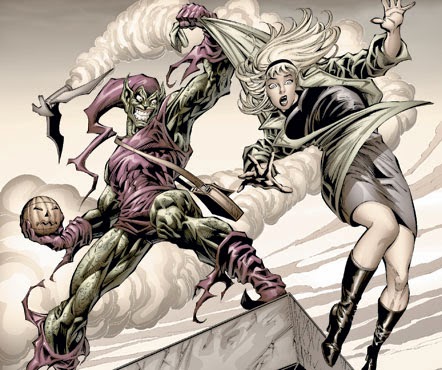
I'm surprised. Her death was one of those moments that defines Spider-man, as much as his Uncle Ben's death. It was so poignant they even paid homage to it in the "Spider-man" movie, when the Green Goblin threatened to throw Mary Jane off the Brooklyn Bridge.
In terms of literary value and defining the character of Spider-man, Gwen Stacy is far superior to Mary Jane, even though Parker married MJ. Think about it: The depths of Gwen's personality and character were never fully explored, and neither was her relationship with Peter, because the Green Goblin killed her. (There was an unusually well-written "What If?" in which they explored what would have happened if Gwen had survived the fall, but that's beside the point.)
In death, Gwen became every bit as defining to Spider-man as Uncle Ben. In the case of Uncle Ben, the lesson Peter Parker learned was the cliched great-power-great-responsibility-yada-yada-yada lesson. Uncle Ben's death carried an important lesson: If you fail to do the right thing, the consequences can be severe. Good people even can die.
Gwen Stacy's death carried a far more brutal lesson. The Green Goblin took her captive precisely because Peter had been doing the right thing. All through high school, and into college, he had been stopping petty criminals and he had been fighting supervillains. The Goblin took her to get at Peter, and although he did everything he could to save her, she died. The goblin killed her for no other reason than because she happened to be Spider-man's girlfriend, and she didn't even know it. The lesson here? You can do the right thing, and people will still die.
In the 20-odd continuity years since her death, she's continued to haunt Parker in a way his Uncle Ben never could, as the innocents he exposes to danger just by being close to people. That's a theme they picked up on in the movie. Even though he saves Mary Jane from the Gwen Stacy fate in a more or less identical situation, he still withdraws from her at the end of the movie because he doesn't want to endanger her. It was a brilliant decision on the part of the filmmakers, even as audience members see Mary Jane realize why Peter is backing away from her.
In my mind, Gwen Stacy towers over Mary Jane precisely because her death was so defining for Spider-man and because her character potential can never be fully realized, while in many ways they've long since exhausted Mary Jane's, at least as long as they insist on keeping her and Peter as childless 20-somethings who have been married an indeterminate but relatively short period.